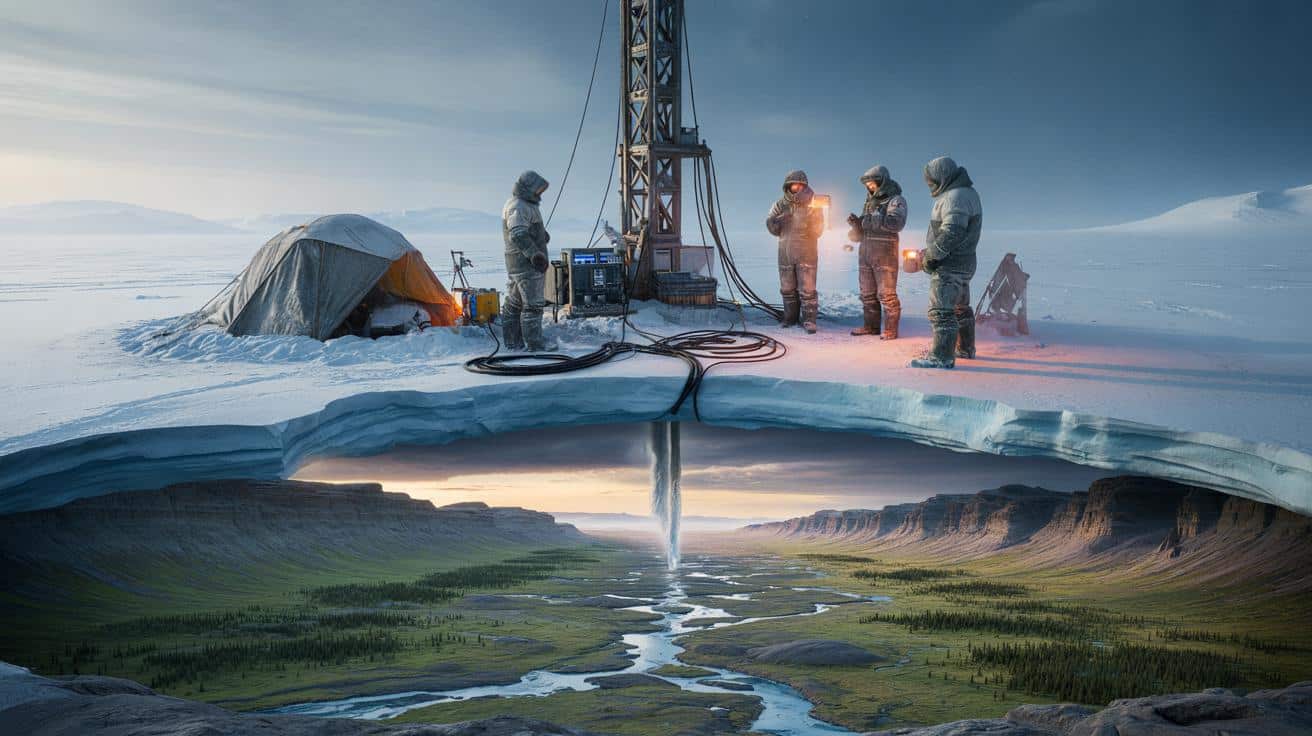
The drill shuddered as it bit deeper into the Antarctic ice, a metal needle sinking into two kilometers of frozen time. The team huddled in the pale blue light of the polar afternoon, breath steaming, eyes glued to flickering monitors. Outside, the wind screamed across a landscape that hasn’t seen a tree, a flower, or even bare ground in millions of years. Inside, the hum of the generator sounded almost nervous.
Then the signal changed. The resistance on the drill dipped, the readings shifted, and everyone in the tent fell silent at the same second. One scientist muttered, barely above a whisper: “We’re through.”
What they hit was not just ancient ice. It was a lost world.
Two kilometers down: entering Earth’s forgotten chapter
The numbers are almost absurd when you hear them the first time. Two kilometers of ice above your head. A world sealed off for 34 million years. Temperatures far below freezing, yet traces of a landscape that once knew sun, rain, and seasons.
Standing on the Antarctic plateau, you don’t see any of that. You just see white. White sky, white ground, white horizon. The idea that a lush, river‑cut world might lie hidden under your boots feels like a trick of the imagination. Still, that’s exactly what satellite scans and ice cores have been whispering for years: Antarctica wasn’t always frozen, and the proof is trapped below.
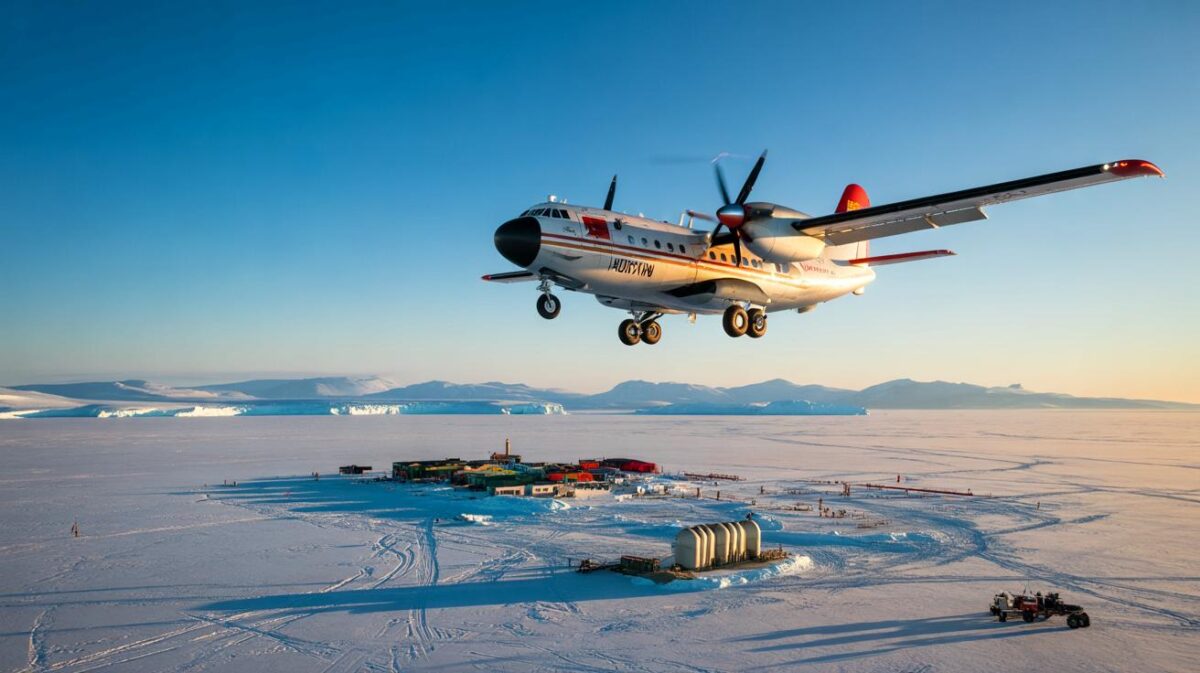
The breakthrough came when radar pulses, fired from research planes, started bouncing back strange patterns from under the ice. Not smooth bedrock, not random bumps. Clear shapes. Valleys. Plateaus. What looked suspiciously like an ancient river system frozen in mid‑flow.
Then the drill cores followed. Grains of ancient sediment. Pollens and spores. Chemical traces of plants that should not exist anywhere near the South Pole. Each fragment a tiny, stubborn message: once upon a time, Antarctica was green. A place where forests creaked in the wind, where water ran in open streams, where life had room to experiment.
Scientists now talk about this buried landscape as if it were a paused movie. Around 34 million years ago, as global temperatures dropped and CO₂ levels fell, Antarctica crossed a tipping point. Ice didn’t just appear; it spread, thickened, locked the continent into a cryogenic state. Rivers were smothered. Hills were erased from view. Entire ecosystems were pressed under layer after layer of snow that hardened into ice.
The reason this hidden world matters isn’t just nostalgia for a greener planet. It’s a living archive of how Earth flips from warm to cold, and what happens to oceans, climate, and species when that switch is thrown. Open that archive, and you’re not just reading the past. You’re getting a preview of what might come next.
How you drill into deep time without breaking it
There’s nothing simple about sending a drill through two kilometers of pure ice without contaminating what waits below. You don’t just show up with a big machine and “go down.” Every meter is planned, logged, measured, argued over in late‑night video calls between engineers and glaciologists scattered across three continents.
➡️ Hair professionals say this cut is perfect for hair that gets flat by midday
➡️ One sock is enough: the grandma trick to clean your blinds like new without effort
The team uses a carefully designed drill that melts its way down, leaving as clean a path as possible. Heated water circulates in a controlled loop, computers track the angle and pressure, and every drop that comes back up is sampled like liquid gold. One wrong move, and you risk flushing modern microbes into a world that hasn’t seen them since before humans existed.
We’ve all been there, that moment when you’re finally opening something you’ve waited on for years and your hands feel clumsy. Now scale that up to an operation that costs millions and involves specialists who have trained their entire careers for one shot.
At one deep‑ice site, just reaching the old landscape took weeks of round‑the‑clock work in brutal cold. Then, in the slurry at the very bottom, they began to find clues: grains of sand shaped by running water, not ice. Bits of rock that had clearly tumbled downstream. Chemical fingerprints that matched wetter, warmer conditions. One researcher compared it to “vacuuming the dust off a buried city you can’t see yet, but you know is there.”
Behind the romance of a “lost world” sits a mess of very human challenges. People get exhausted. Machines break at the far end of the Earth. Funding deadlines loom. Let’s be honest: nobody really reads every technical report line by line every single day.
Yet the good teams slow down at the hard parts. They double‑check temperatures, recalibrate sensors, repeat the dull safety checks. They argue kindly, not cruelly, when the data looks weird. *That’s the quiet method behind discoveries that sound almost mythical when they finally hit the news.* By respecting the ice as both a physical barrier and a fragile archive, they avoid turning a once‑in‑history sample into a spoiled mess.
What this buried world is trying to tell us now
The real shock isn’t that Antarctica used to be green. Geologists suspected that for decades. The shock is how quickly it appears to have changed once the climate reached a certain threshold. The sediments from under the ice show rivers that suddenly stop, plant traces that vanish, erosion that simply…ends. Almost like someone flipped a giant planetary switch from “temperate” to “deep freeze.”
For climate scientists, this buried landscape is a warning flare. It shows that ice sheets don’t always melt or grow politely, millimeter by millimeter. There are tipping points where coastlines jump, where ecosystems struggle to keep up. The lost Antarctic world is a case study in what crossing such a threshold really looks like.
There’s also a more personal layer to this story. Many of us grew up with a fixed mental picture of Antarctica: a white desert, eternal and unchanging. Learning that it once held forests and rivers can feel strangely emotional, almost like finding old photos of a grandparent living a life you never imagined.
This discovery nudges us to let go of the idea that the places we know have always been this way. Cities under rising seas, shifting storm tracks, vanishing glaciers—they suddenly make more sense when seen through a 34‑million‑year lens. The continent at the bottom of the world turns into a kind of mirror, reflecting choices we’re making right now about energy, consumption, and what kind of world we want to hand over.
“Antarctica is not just a block of ice,” one researcher told me. “It’s a memory. Under those two kilometers, the planet has written down what happens when climate crosses certain lines. We’d be foolish not to read it carefully.”
- Hidden rivers and valleys
Radar maps reveal an entire drainage network carved before the ice, proof of a once‑living landscape. - Evidence of ancient forests
Pollen, spores, and chemical signatures point to vegetation thriving where today only ice survives. - A climate tipping point in slow motion
Sediments record how a warming or cooling planet can abruptly lock into a new state. - Lessons for modern sea‑level rise
Studying this buried world helps refine models that predict how fast ice sheets might shrink today. - A humbling timescale
Thirty‑four million years of history under our feet puts our current century into sharp perspective.
A lost world under the ice, and the thin present we stand on
It’s strangely grounding to realize that the ground itself has changed so radically. That a place we now treat as the end of the Earth was once just another patch of green, with flowing water and slow, patient evolution. The Antarctic ice sheet feels less like a permanent shield and more like a pause button pressed halfway through a story.
Some of the scientists who work there say the real weight hits them not in the lab, but on the flight home. You leave a continent that stores 34 million years of climate memory under two kilometers of ice. Hours later, you’re back in cities built exactly at sea level, where people argue over short‑term budgets while the long‑term script is already written in buried landscapes.
This lost world doesn’t give clear instructions or simple solutions. It just refuses to let us pretend that Earth is static or slow. It shows that continents move, climates flip, oceans rise and fall, and that these shifts can be both gradual and brutally sudden.
Some readers will feel a surge of anxiety in front of that truth. Others might feel a kind of fierce curiosity, a desire to know as much as possible while we still can. Both reactions are honest. Both are part of waking up to a planet that is not a backdrop, but a restless, remembering system.
The next time you see yet another headline about Antarctica melting, you might remember that under the ice there’s a ghost landscape that once had rain, soil, and leaves. That the line between “frozen forever” and “open water” has been crossed before. And that a group of tired, stubborn people stood in a noisy drill tent at the bottom of the world, chasing signals from a time when the map of Earth looked almost familiar and completely different at once.
What we choose to do with that knowledge is still unwritten.
| Key point | Detail | Value for the reader |
|---|---|---|
| Antarctica once had rivers and forests | Radar mapping and sediments reveal ancient valleys, flowing water, and plant traces under 2 km of ice | Changes your mental map of the planet and shows how radically climates can shift |
| Ice sheets can flip at tipping points | Evidence suggests a relatively rapid transition into deep freeze about 34 million years ago | Helps you understand why modern warming could trigger abrupt sea‑level and climate changes |
| Drilling deep ice is delicate, human work | Careful methods prevent contamination and protect a unique climate archive | Builds trust in the science and connects the discovery to real people and choices today |
FAQ:
- Question 1What exactly did scientists find under the Antarctic ice?
- Answer 1They found evidence of an ancient landscape—valleys, river systems, and sediments—along with microscopic traces that point to past vegetation and a much milder climate.
- Question 2How do we know this hidden world is about 34 million years old?
- Answer 2By dating the sediments and comparing them with known global climate shifts, especially the major cooling event when Antarctica first became permanently glaciated.
- Question 3Could there still be life under the ice today?
- Answer 3Yes, but it would likely be microbial. Lakes and groundwater sealed under the ice may host hardy bacteria and archaea adapted to dark, cold, low‑nutrient conditions.
- Question 4Does this discovery mean Antarctica will become green again?
- Answer 4Not in any near human timeframe. The finding shows that a green Antarctica is possible under different climate conditions, but reversing the current ice sheet would take extreme, sustained warming.
- Question 5Why should non‑scientists care about a world buried so long ago?
- Answer 5Because it reveals how Earth’s climate system behaves at the edges, including how fast ice sheets can grow or shrink—knowledge that directly affects future sea levels, coastal cities, and global weather.