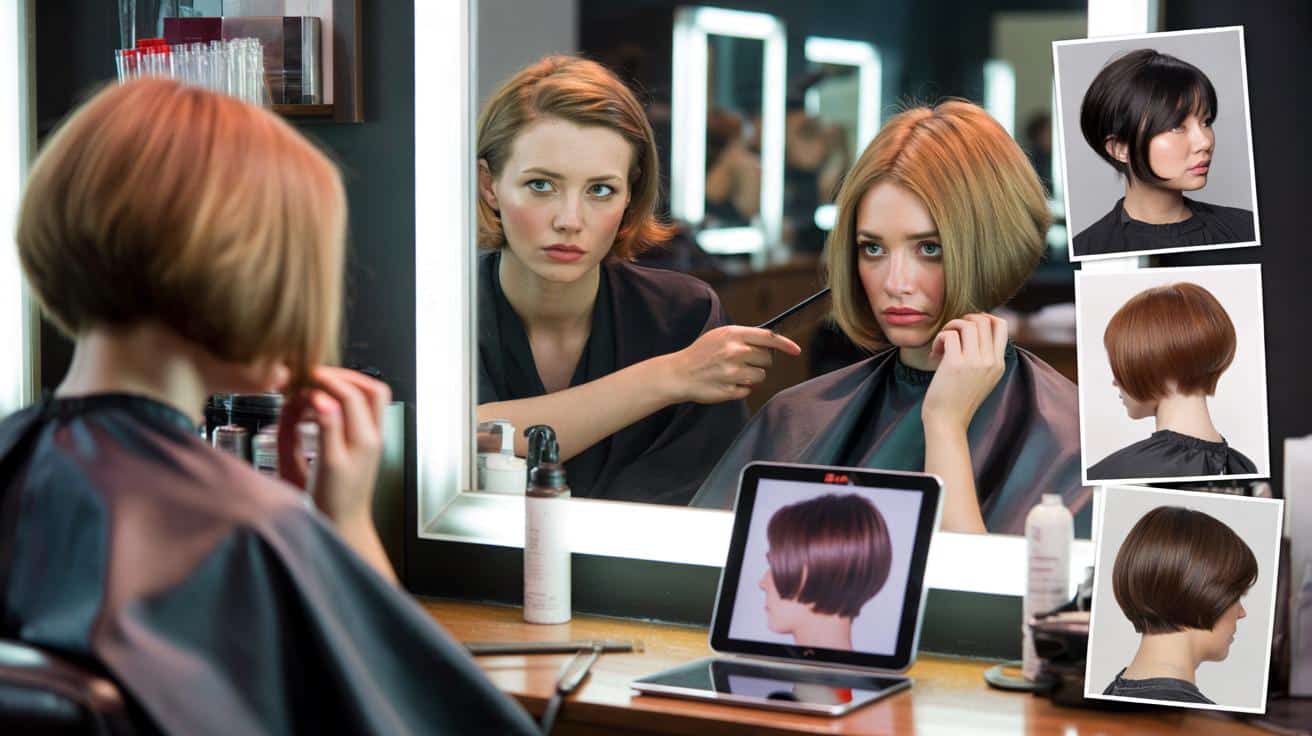
The salon was buzzing, the way it always does on a Saturday when everyone’s chasing a new version of themselves. A woman in her thirties slid into the chair next to mine, clutching screenshots of celebrities with airy bobs and fluffy pixies. “My hair is so flat,” she sighed, fingers disappearing in fine, slippery strands. “I just want volume. Chop it off.” The stylist paused for a beat too long. Then she said the sentence nobody wants to hear right before a big hair change: “We need to talk about what this cut will look like on you… in three weeks.” The woman laughed it off, like most of us do.
She didn’t laugh when she came back a month later with a hat on.
Some short cuts don’t just fall flat. They quietly sabotage fine hair.
Why some “volume-boosting” short cuts backfire on fine hair
There’s a strange irony with fine hair. The cuts that look the most volumizing on Instagram can turn into sad, deflated shapes in real life. Especially once you’ve washed your hair at home, slept on it twice, and used your regular shampoo again. Stylists see it every week: a client arrives dreaming of a crisp blunt bob or a stacked pixie, and walks out with a style that’s technically on-trend but secretly doomed for collapse.
The problem isn’t your hair. It’s the way some shapes fight against its natural weakness.
One London stylist told me about a client who begged for a super-layered, stacked bob “for lift.” On day one, it was gorgeous. The back was puffed up, the crown rounded, the nape clean. She took a dozen selfies. Two weeks later, she returned furious. The weight at the front had collapsed, the crown was stuck to her head, and the stacked back was exposing her scalp in tiny white flashes every time the wind moved.
What looked dense and sculpted in the salon looked **thin and patchy** in daylight.
This story repeats in big cities and small towns, just with different faces.
Fine hair has less diameter per strand and often less density per square centimeter of scalp. When you remove too much length or carve in aggressive layers, you don’t “free” the hair. You strip away the last bits of weight that were giving it substance. Every snip reduces how much hair covers each section of the head. That’s why some short cuts create gaps, collapse at the roots, and exaggerate cowlicks and flat spots.
On screens these cuts look light and bouncy. On a real head with real growth patterns, they can look like a style that’s already one bad blow-dry away from regret.
The 4 risky cuts stylists quietly warn fine-haired clients about
The first repeat offender is the heavily stacked bob. From the back, it looks almost triangular: short and steep at the nape, then suddenly longer at the front. Stylists say it can be lethal on fine hair because all the “stack” relies on density that just isn’t there. Once you wash it yourself, the rounded shape flattens into a tiny ledge at the back and a limp curtain in front.
If your hair is fine and a bit see-through at the ends, that sharp angle will highlight every sparse spot hiding underneath.
The second risky one is the ultra-piecy pixie with extreme texturizing. On TikTok it looks fun and feather-light. On real fine hair, those razored layers can shred what little bulk you have. After a few weeks, the cut stops looking “piecey” and starts looking simply… thin. Then comes the “micro-bob”: that jaw-length, blunt-ish bob with no strategic internal support. When it’s too short and too blunt, fine hair can cling to the head like wet paper.
We’ve all been there, that moment when you see the back of your head in a photo and realize your “volume cut” has turned into a helmet.
The fourth trap is the cropped shag or mini wolf cut. It promises rock-chic lift and movement. On fine hair, all those chopped-up layers can create stringy sections that refuse to blend. Roots lie flat, ends flip in five directions, and styling takes forever. Let’s be honest: nobody really does this every single day. A shag can be magic on thicker hair, but on baby-fine strands it often looks best right after a professional blow-dry… and then slowly devolves into an uneven, fragile shape you can’t grow out fast enough.
That’s the plain truth stylists warn about when you ask them what they’d “never” do on your hair type.
How to ask for short hair without sabotaging fine strands
The safest way to get a shorter cut on fine hair is to talk in terms of weight, not length. Ask your stylist where they plan to remove bulk and where they’ll preserve it to protect density. A softly layered bob that sits just below the jaw, with invisible internal layers at the back only, often works better than a dramatic angle. You’re looking for subtle scaffolding, not harsh architecture.
One smart move: ask for a cut that looks good air-dried, even if you blow-dry most days. If it only works when perfectly styled, it will betray you on rushed mornings.
Stylists also stress that fringe choices can make or break fine hair. A heavy, straight-across fringe can steal too much hair from the rest of your head, leaving the sides looking see-through. A wispy, slightly longer curtain fringe usually plays nicer, adding softness without thinning out your overall shape. Many people think shorter automatically means fuller. On fine hair, a touch more length often gives the illusion of thickness because the strands can overlap and support each other.
*i.e., sometimes the most “volumizing” thing you can do is not cut quite as short as you planned.*
“Fine hair needs strategy, not drama,” says Claire, a Paris-based stylist who sees a lot of haircut regret. “If someone shows me a very stacked bob or a shredded pixie, my first question isn’t ‘Do you like it?’ but ‘How does your hair behave when it’s dirty, wet, or unstyled?’ That’s when the truth shows up.”
➡️ Which colours make us look older according to psychology?
➡️ Beware black ice: 9 smart ways to avoid winter slips on snow and ice
- Ask for softness at the edges – Hard, geometric lines highlight any lack of density.
- Keep the nape slightly longer – A tiny bit of extra length at the back stops the cut from “lifting up” and exposing scalp.
- Limit aggressive thinning – Toning down razoring and texturizing helps preserve fullness over time.
- Plan the grow-out – A cut that has a graceful Plan B at 4–6 weeks feels less risky on fragile strands.
Rethinking “volume” when you live with fine hair
Maybe the real shift is this: volume on fine hair isn’t a haircut you copy. It’s a quiet negotiation between what your hair naturally does and what your life realistically allows. Some of the most flattering short cuts on fine hair look almost “too simple” on a mood board, but stunning in motion: a soft neck-grazing bob, a gentle bixie with minimal layers, a clean crop with a little fullness left at the crown. These are the cuts that still look like you after you’ve slept on them, commuted, gone out, and skipped a wash day.
They don’t shout. They just don’t betray you.
If you’ve ever walked out of a salon feeling ten years lighter, then spent the next month hiding under dry shampoo and clips, you know the psychological cost of a bad short cut on fine hair. It’s not just “hair.” It’s stepping into a meeting wondering if the person behind you can see the back of your head through your crown. The stylists raising quiet red flags about stacked bobs, over-textured pixies, and mini shags aren’t trying to kill your fun. They’re trying to steer you toward shapes that will still feel like a good idea long after the blow-dry has faded.
The question isn’t “Which cut gives instant volume?”
It’s “Which cut will I still love when no one is styling it but me?”
| Key point | Detail | Value for the reader |
|---|---|---|
| Avoid over-stacked and over-layered shapes | Heavily angled bobs, cropped shags and ultra-textured pixies strip away precious weight | Reduces the risk of flat roots, visible scalp and fast haircut regret |
| Preserve strategic length and density | Soft bobs, gentle bixies and minimal internal layers keep hair looking fuller | Helps fine hair appear thicker without demanding daily salon-level styling |
| Plan for real life, not just day-one styling | Choose cuts that still look good air-dried and at 4–6 weeks of growth | Ensures your haircut feels reliable and confidence-boosting over time |
FAQ:
- Question 1Which short haircut is safest for very fine, flat hair?
- Answer 1A slightly below-jaw blunt bob with soft internal shaping at the back is usually the most forgiving. It keeps edges clean while preserving enough weight to avoid see-through ends.
- Question 2Are pixie cuts always bad for fine hair?
- Answer 2Not always, but they need to be done with restraint. A compact pixie with minimal texturizing and a bit of softness around the hairline works far better than a heavily razored, spiky version.
- Question 3How short can I go without losing all my volume?
- Answer 3For most people with fine hair, anything shorter than cheekbone level starts to risk looking sparse. Stopping around lip to jaw level usually keeps enough coverage for a fuller look.
- Question 4Do layers ever help fine hair?
- Answer 4Yes, when they’re subtle and placed with intent. Soft, long-ish layers hidden inside the cut can add movement without removing the density you see on the surface.
- Question 5What should I tell my stylist to avoid a regret cut?
- Answer 5Say clearly that your priority is keeping the hair looking thick, not ultra-light. Ask them to avoid aggressive thinning, extreme stacking, or very short layers, and to design a shape that grows out gracefully.