The argument started with a single lock of hair.
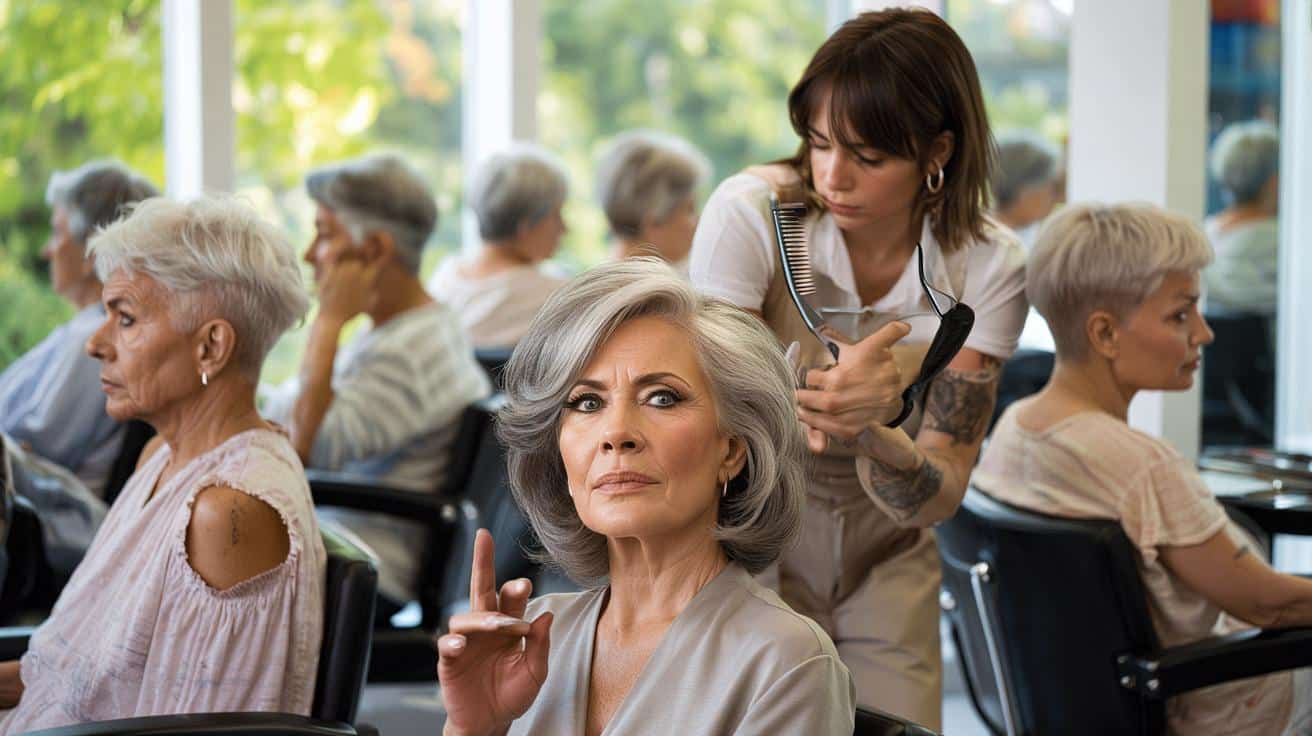
At a bright salon on a Tuesday morning, 74‑year‑old Marianne watched long silver waves fall to the floor while a young stylist chirped, “You’re going to love your new Trixie cut, it’s what all the magazines are talking about for spring.” Her daughter nodded politely, scanning Pinterest on her phone, not quite convinced. When Marianne turned toward the mirror, her eyes widened. The woman looking back wasn’t “rejuvenated”. She was… someone else.
Around her, other older women sat in identical chairs, leaving with the same short, choppy fringe and stacked layers. Different lives, same haircut.
Outside, on the pavement, Marianne whispered the sentence that so many grandmothers, aunts, and neighbors are quietly repeating this season.
“Why are they all trying to erase my age?”
Why the “Trixie cut” is everywhere — and why so many women over 70 are saying no
Walk into almost any trendy salon this spring–summer and you’ll hear it: the sales pitch for the famous Trixie cut. Short at the nape, lifted crown, choppy sides, a playful fringe that’s supposed to “open up” the face. It’s the current darling of hairdressing Instagram, branded as the miracle shortcut to looking ten years younger.
Stylists post before‑and‑after reels where older women emerge from a cloud of hairspray looking like energetic, fashion‑forward grandmas. The message is clear: pass 70, this is the *only* cut that proves you’re still “with it”.
Not everyone is clapping.
Take Rosa, 79, who walked into a busy chain salon with a photo of her favorite actress, long bob grazing her shoulders, soft waves, plenty of movement. The young hairdresser barely glanced at the picture. “You don’t want that, it will drag your face down. I’ll do a Trixie, you’ll see, it’s much fresher.”
Forty minutes later, Rosa left with the same spiky, graduated bob she’d seen on three other clients. Her grandson blurted out, “Abuela, why did they give you the same haircut as my teacher?” The family laughed, but she went quiet.
Stories like this now flood Facebook groups for seniors and caregivers. Some posts are angry, some sad. Many say the same thing: “I asked for something else. I got the Trixie cut anyway.”
What’s really happening goes beyond hair. Salons are under pressure from social media trends and product brands hungry for viral “transformations”. A standardized, quick‑to‑style cut like the Trixie is a dream for busy hairdressers. It photographs well, works with plenty of texturizing sprays, and fits the current obsession with “anti‑age” everything.
➡️ What it reveals psychologically when you feel the need to prepare emotionally for simple situations
For older women, though, the message stings. **When one trendy cut is framed as the only way to look modern after 70, everything else is quietly labeled “outdated” or “letting yourself go.”** The nuance of personality, health, culture, and comfort disappears behind a catchy name.
Let’s be honest: nobody really walks into a salon at 73 wanting to come out looking like every other 73‑year‑old.
How to push back in the chair: reclaiming your haircut without starting a war
The battle actually starts before you sit down. The most effective gesture isn’t dramatic; it’s a calm, clear sentence right at the shampoo bowl: “I don’t want the Trixie cut. I want this,” followed by a printed photo, not just your phone screen waved in the air.
Ask the stylist to describe, in their own words, what they’re planning to do. Not just “layers” or “shape,” but where the length will fall on your neck, how short the fringe will be, how much volume they’ll cut into the crown. When you hear words like “stacked back” or “pixie‑style sides” and your stomach drops, that’s the moment to pause.
You’re not being difficult. You’re being precise about your face.
Many seniors say they feel rushed or slightly bullied into quick decisions. You’re handed a magazine full of 40‑year‑olds, then shown the same three photos of “youthful” short cuts. If you’re feeling intimidated, say it out loud: “I need time. I don’t want a drastic change today.”
Big mistake number one is staying silent just to be “nice.” Stylists can be talented and still have blind spots about age. Big mistake number two is assuming they know your limitations: arthritis in your hands, a sensitive scalp, maybe you can’t hold a hairdryer for 15 minutes. A high‑maintenance Trixie cut on someone who can’t style it daily is a recipe for resentment.
There’s nothing ungrateful about saying, **“I need something I can manage alone at home.”**
Sometimes the real conflict isn’t between the client and the stylist, but between generations sitting in the same salon chair.
One 72‑year‑old woman told me, “My daughter kept saying, ‘Mom, just trust her, it’ll make you look younger.’ I had to remind her, I don’t actually want to look younger. I want to look like myself, just polished.”
- Bring 2–3 photos of women close to your age, not celebrities half your age.
- Say clearly what you like: “I want my neck covered,” “I like my ears hidden,” “I love softness around my face.”
- Say clearly what you fear: “I don’t want spiky texture,” “I don’t want volume only on top.”
- Agree on a maximum length to cut: “No shorter than the bottom of my ear / top of my collarbone.”
- Ask for a “test length”: stop halfway, check the mirror, then decide if you go shorter.
These small boundaries often do more than any big speech about ageism.
Beyond the trend: hair after 70 as a living memory, not a problem to solve
Hair after 70 holds entire chapters of a life. Wartime braids, wedding updos, the bob you wore when you got your first paycheck, the curls your partner used to tuck behind your ear. When a stylist slices all that away in the name of “freshness,” the shock runs deeper than vanity.
Many older women say they feel erased, as if the story of their faces must be cropped into something “on trend” to still be respected. Others quietly accept cuts they hate because they don’t want to sound old‑fashioned or “fussy” in front of younger relatives. Yet something is changing this season: daughters, grandsons, friends are starting to push back, asking salons why every woman over 70 is being funneled into the same edgy silhouette.
You see it in small acts. A granddaughter who walks in with her nan and says, “She wants her long braid refreshed, not chopped.” A 76‑year‑old who brings a printed page that reads, in large letters: “NO TRIXIE CUT. WANT: SOFT BOB, SHOULDER LENGTH.” A son who calls the salon ahead of time and explains his mother’s dementia, asking for minimal change so she still recognizes herself.
These gestures may sound trivial from the outside. Inside the chair, they’re anything but. They say: your age is not a mistake, your wrinkles are not a problem to fix with a fringe, your white hair doesn’t need to “pop” to be allowed in the room.
*Maybe the real spring–summer trend isn’t a choppy crop with a catchy name, but something quieter and harder to sell:* older women deciding, very simply, that they’re done apologizing for looking over 70.
The Trixie cut will fade, like the layered shag, the perm, the mullet. What will stay is the memory of who stood up gently in the salon and said, “This face has seen decades. Treat it as a whole, not as a project.”
If you’ve watched a mother, aunt, or neighbor come home in tears because “they cut too much,” you already know what’s at stake. Hair grows back, yes. So does resistance. And next time a stylist says, “At your age, everyone is doing this new cut,” more and more women are simply answering, “Well, I’m not everyone.”
| Key point | Detail | Value for the reader |
|---|---|---|
| Trend pressure | Salons push the Trixie cut as the default “rejuvenating” option for women over 70 | Helps you recognize when you’re being sold a trend instead of being heard as an individual |
| Clear communication | Use photos, precise language, and limits on length to avoid unwanted drastic changes | Gives you practical tools to leave the salon with a cut you actually recognize and enjoy |
| Respecting identity | Hair after 70 is tied to memory, dignity, and daily comfort, not just style | Encourages you and your family to defend choices that honor your age rather than hide it |
FAQ:
- Question 1Is the Trixie cut always a bad choice for women over 70?
- Answer 1No. Some women genuinely love it and feel lighter and more confident. The issue isn’t the cut itself, but when it’s pushed as the only “acceptable” modern option after a certain age.
- Question 2How can I tell if a stylist is really listening to me?
- Answer 2They repeat back what you said in their own words, show with their fingers where the length will fall, and ask about your routine. If they brush off your concerns or rush you, that’s a warning sign.
- Question 3What if my family keeps telling me to cut my hair short to look younger?
- Answer 3You can simply say, “I’m not looking for younger, I’m looking for myself.” Your hair is part of your identity, not a group project. Invite them to support comfort and confidence instead of chasing age.
- Question 4Are long or mid‑length styles really practical after 70?
- Answer 4They can be, if cut and layered with your abilities in mind. A blunt shoulder‑length bob or a soft layered lob often needs less styling than a heavily textured cropped cut.
- Question 5What should I say if the stylist insists a Trixie cut is “better for my face”?
- Answer 5Try: “I appreciate your opinion, but I’m choosing based on how I feel, not just face shape. Let’s work within the length and shape I’ve shown you.” If they push harder, you’re allowed to stand up and leave.