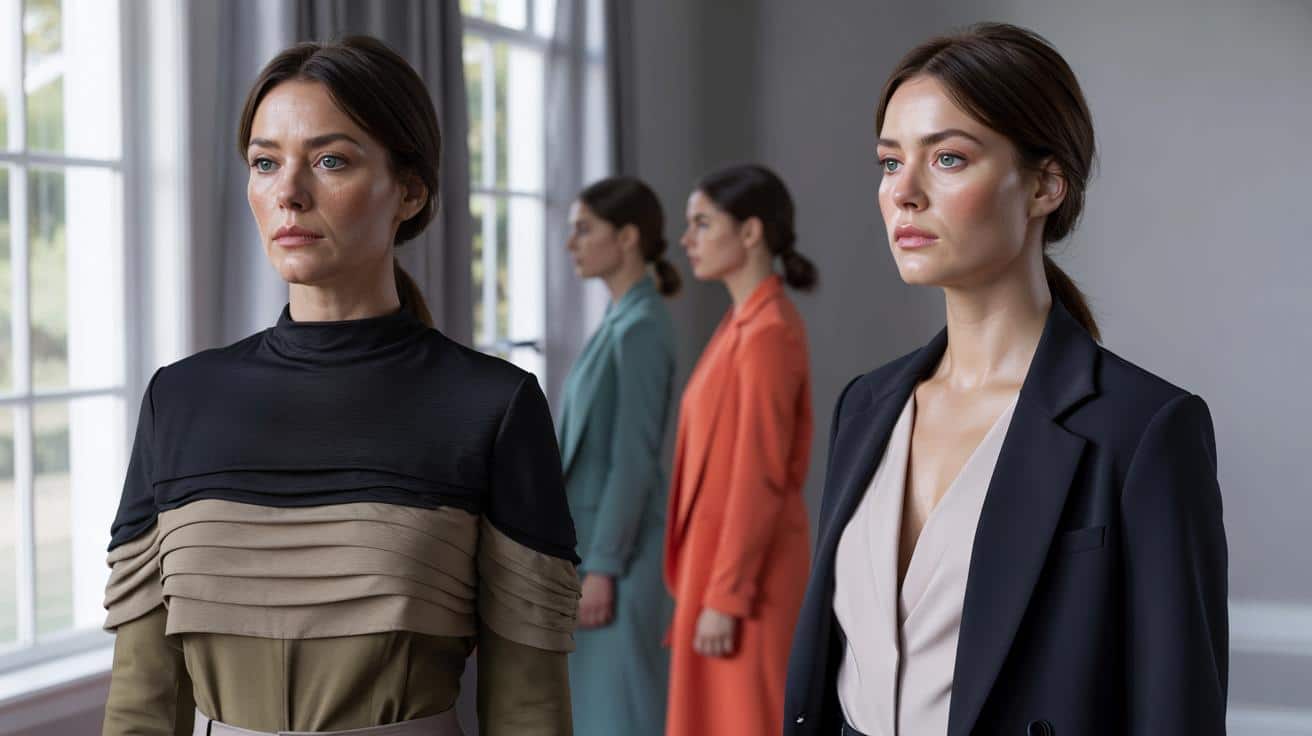
You pull a favourite sweater over your head, glance at the mirror… and pause.
The cut is right, the fabric is good, yet something feels off. Your face looks drawn, shadows under the eyes stand out, and there’s a strange dullness you can’t quite name. You didn’t sleep that badly, did you?
Then you remember: in photos where you feel “old”, you’re often wearing the same colour.
That one tone that seems to drain the light from your skin and add five years in a second.
We talk about wrinkles, skincare, haircuts. We rarely talk about the colour that quietly ages us in broad daylight.
Psychologists do.
When colour quietly adds years to your face
Psychologists know we don’t see faces in isolation.
We see a face inside a colour frame: clothes, background, lipstick, lighting. And some frames are brutal.
Harsh blacks, dirty beiges, tired greys, acid yellows – these shades can harden features and deepen every line.
They pull contrast away from the eyes, drain natural redness from lips and cheeks, and exaggerate under-eye circles.
We don’t consciously say “this colour makes you look older”.
Our brain simply reads: less vitality, less warmth, less health. Age.
A 2021 experiment from the University of Bern showed volunteers random faces with different clothing and background colours.
Faces surrounded by low-saturation, “dusty” tones were consistently rated as older and more tired than the exact same faces paired with fresher, clearer colours.
One of the researchers summed it up in a dry sentence: change the colour, change the perceived age.
People in dull beige or murky khaki were seen as less energetic than those in light blue or soft coral, even though the facial photos were identical.
Nothing on the skin had changed.
Only the colours around it.
Psychologically, this is simple.
Our brain uses colour as a shortcut to judge health and vitality.
➡️ According to psychology, the way you react to criticism says a lot about your self-esteem
When a colour echoes bruising tones – yellowish, sallow, greenish-beige – the face looks more fatigued.
When a colour is much darker than our natural contrast, like heavy black against pale skin, the lines and shadows stand out like under a spotlight.
*We don’t read “this person is wearing a tricky shade of taupe”.*
We read “this person is more tired and probably older”.
The colour did the talking before we even realised.
The colours that age us… and how to dodge them
The first move isn’t to throw away half your wardrobe.
It’s to test which “ageing” colours are guilty on you.
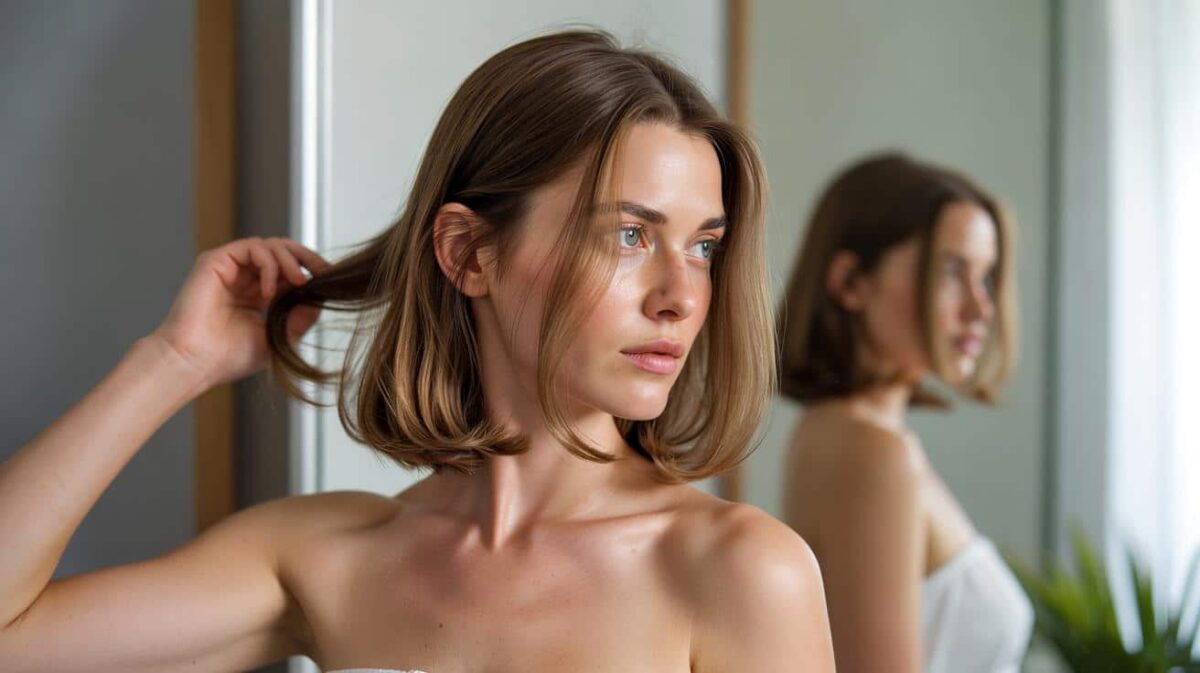
Stand near a window with a mirror and hold different tops or scarves under your chin.
Try pure black, beige, mustard yellow, muddy olive, very cool grey, and neon shades.
Look only at your face: do your teeth look slightly yellower, your dark circles deeper, your skin more uneven?
If a colour makes you instantly reach for concealer in your head, that shade is aging you.
Many people get stuck on black.
They’ve heard it’s slimming, chic, safe. And it can be, just not for everyone, and not near the face all the time.
For very fair skin, full black at the neckline can carve the face, making cheeks look hollower and lines more dramatic.
For warm, golden complexions, a cold charcoal or blue-toned black can add a grey veil, like you’re recovering from the flu.
We’ve all been there, that moment when you put on a black turtleneck and suddenly look like your own strict teacher.
The problem isn’t you. It’s the contrast game your brain is playing.
Colour psychologist Angela Wright once said: “Colour doesn’t just decorate us, it edits us. It can edit out ten hours of sleep, or ten years of life.”
- Colours that often age pale skin: pure black, muddy brown, mustard yellow, dirty beige, very cool blue-based fuchsia
- Colours that often age olive or medium skin: ashy greys, dull khaki, dusty mauve, cold lavender, some neon greens
- Colours that often age deep skin tones: chalky pastels, greyish nude, very cool silver-grey, faded navy, “foundation” beige
- Shades that tend to flatter most people: fresh navy, soft white, true red, teal, clear berry, warm coral, rich chocolate brown
- Plain-truth sentence: Let’s be honest: nobody really does this every single day, but one slow Sunday with a mirror can change your whole week of outfits.
Beyond age: what your colour choices quietly say
Once you’ve spotted the culprits, the question becomes less “What makes me look older?” and more “What makes me look like myself?”.
That’s where things get unexpectedly emotional.
Some people cling to ageing colours for symbolic reasons.
All-black to feel slimmer, beige to blend in at work, neon to “look fun” even when exhausted.
Psychology shows we often dress not for how we look, but for the story we’re trying to tell.
The risk is when that story writes extra years on our face.
You might notice this at family gatherings.
There’s always that aunt who dresses in powdery, faded pastels that match the curtains, and everyone thinks she’s older than she is.
Then there’s the colleague who suddenly swaps grey jumpers for a soft teal blouse.
People say: “You look so rested!” even though nothing in her life has calmed down.
They’re responding to what that colour does to her eyes, her skin, her presence in the room.
Not to the number on her birth certificate.
At some point, we stop chasing “young” and start chasing “alive”.
Colour is one of the fastest ways to send that signal, to others and to ourselves.
You don’t have to live in bright tones or dress like a mood board.
Even one scarf, one T-shirt, one lipstick that lifts your face can shift how your age is read on a bad day.
And sometimes, the real surprise is a colour you swore you could “never wear”.
Then you see it in natural light, and you look like you just came back from a week of good sleep and good news.
| Key point | Detail | Value for the reader |
|---|---|---|
| Test colours near your face | Use natural light, compare how your skin, eyes and shadows react to different shades | Quickly spot which colours age you and which ones brighten you |
| Avoid “bruise” and “dusty” tones | Yellowish beiges, muddy olives, ashy greys often signal fatigue and age | Reduce the tired, older look without changing anything on your skin |
| Use flattering neutrals and accents | Soft white, navy, teal, true red, coral, rich browns flatter most tones | Build an easy, realistic wardrobe that supports a fresher, more vibrant face |
FAQ:
- Question 1Do “ageing colours” exist for everyone, or is it just in my head?They exist as a perception pattern. The exact shades differ for each person, but psychology studies show consistent links between certain colour families and how old or tired a face looks.
- Question 2Is black always a bad idea if I don’t want to look older?No. Black can look sharp and powerful. It tends to age when the contrast with your skin is too strong or your features are soft. Keeping black away from the neckline, or pairing it with a bright scarf or lipstick, often solves the problem.
- Question 3Can makeup compensate for ageing colours?It helps. A warmer blush, brighter lip or soft highlighter can fight the dulling effect of a bad colour. But if a shade is truly draining you, makeup often ends up working twice as hard for half the result.
- Question 4How do I know my best colours without paying for a consultation?Use the window test with several tops or scarves, photograph yourself in each, then compare pictures on your phone. The shades where your eyes look clearer and your skin more even are usually your allies.
- Question 5Is it too late to rethink colours after 40 or 50?Not at all. Many people only discover their best palette later in life, once trends matter less. A single well-chosen colour near your face can soften how others read your age, at any decade.