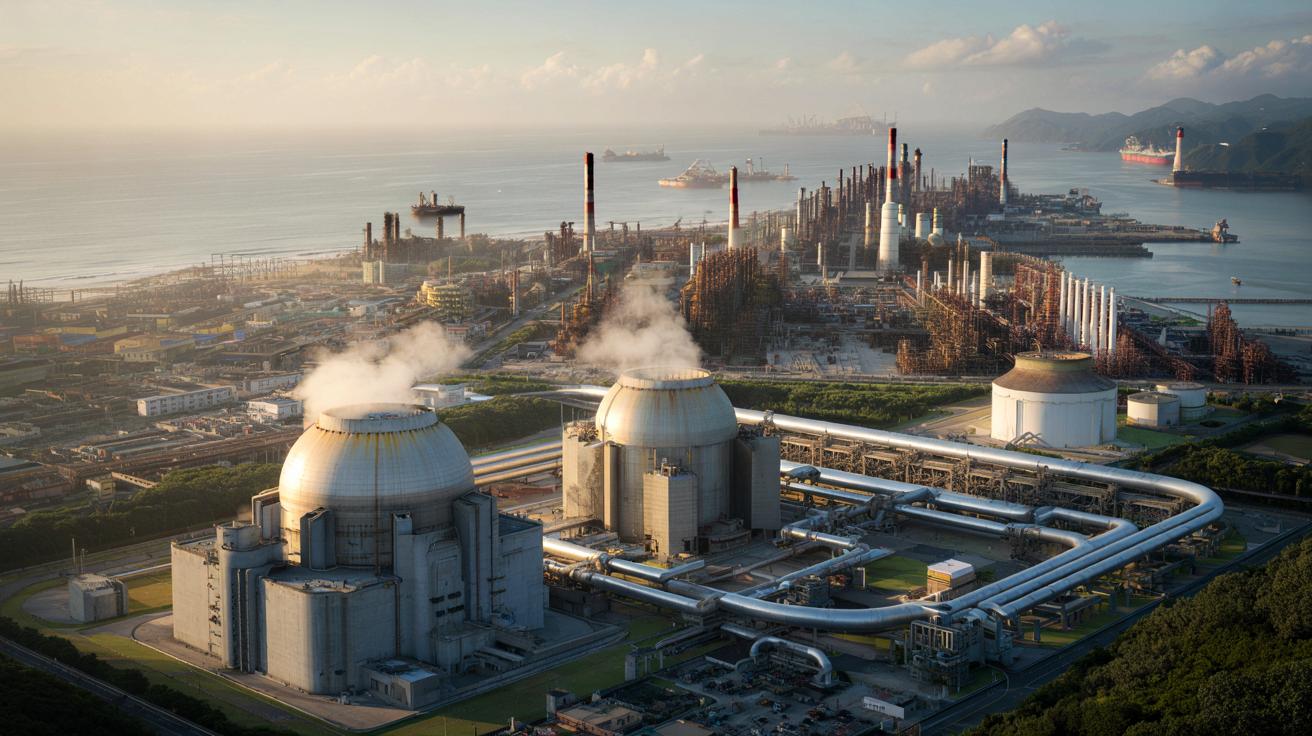
Instead of focusing only on electricity for the grid, this new complex is being built from day one to act like a colossal nuclear boiler, feeding nearby factories with vast amounts of steam while still generating power.
A nuclear plant that behaves like an industrial boiler
The Xuwei nuclear project, in the coastal city of Lianyungang in Jiangsu province, aims to do something no other nation has attempted at commercial scale: combine two different generations of nuclear technology on one site, and design the whole system around the direct supply of industrial heat.
China National Nuclear Corporation (CNNC) presents Xuwei as a demonstration plant, but the numbers look anything but experimental. The facility is expected to deliver electricity for millions of homes while also flooding local petrochemical and chemical parks with high‑temperature steam.
Instead of treating heat as waste from electricity production, Xuwei treats heat as a primary product and electricity as a co‑product.
The project rests on a three‑reactor cluster:
- Two Hualong One pressurised water reactors (PWR), each rated at around 1,200 MW of electrical output
- One high‑temperature gas‑cooled reactor (HTGR) of 660 MW electrical, a so‑called Generation IV design
This mix makes Xuwei the first site in the world where a third‑generation PWR and a fourth‑generation HTGR are physically and thermally coupled as part of one integrated heat‑and‑power system.
How the plant recycles nuclear heat instead of wasting it
A two‑step steam process
Most nuclear plants boil water once and send the resulting steam through turbines, then dump the remaining heat into the sea or a river. Xuwei uses a more intricate approach to squeeze extra value out of that thermal energy.
First, demineralised water is heated using steam from the Hualong One reactors. That produces saturated steam, similar to what a typical plant would feed into its turbines.
Instead of stopping there, the steam passes through a second heating stage. This time, the heat source is the primary circuit of the high‑temperature gas‑cooled reactor.
➡️ What it reveals psychologically when you feel the need to prepare emotionally for simple situations
➡️ How a drop of washing‑up liquid in the toilet can have a surprisingly big effect
➡️ Which colours make us look older according to psychology?
➡️ One sock is enough: the grandma trick to clean your blinds like new without effort
By giving the steam a second thermal “boost”, Xuwei reaches temperatures suited to heavy industry, not just electricity generation.
This double‑pass system allows the installation to maintain a strong electricity output while diverting vast amounts of high‑grade heat to nearby industrial users. The same unit of uranium effectively does two jobs.
Industry first, grid second
When all three reactors are operational, Xuwei is expected to deliver around 32.5 million tonnes of industrial steam per year. That steam will be piped directly to Lianyungang’s sprawling petrochemical, chemical and manufacturing complexes, which currently consume huge volumes of fossil fuels for process heat.
Alongside this, the power station should generate more than 11.5 billion kilowatt‑hours of electricity annually. That is comparable to the yearly consumption of several million Chinese households, while still prioritising heat supply to factories.
Xuwei reverses the usual logic of nuclear plants: it treats factories as the main customer and the national grid as a high‑value side client.
Cutting coal out of China’s industrial heartlands
Carbon savings on a national scale
China’s industrial sector burns staggering amounts of coal to produce steam for refineries, chemical plants and heavy industry. Replacing even a fraction of that coal with nuclear heat can have a tangible impact on emissions.
Official projections for Xuwei estimate annual savings of:
- 7.26 million tonnes of standard coal avoided
- 19.6 million tonnes of carbon dioxide emissions prevented
Those figures alone exceed the yearly emissions of some smaller European countries. They also hint at Beijing’s broader strategy: decarbonise not just electricity, but the harder business of industrial energy use.
An industrially heavy project, not a science fair
The construction contract for Xuwei, signed in late 2025, is worth around €560 million for the conventional island and auxiliary equipment. It went to a consortium led by China Energy Engineering Jiangsu Electric Power Construction No.3 and China National Nuclear Huachen Construction Engineering.
Key responsibilities include:
- Building conventional islands for all three reactors
- Installing auxiliary systems such as steam pipelines and heat‑delivery infrastructure
- Supplying non‑nuclear equipment critical to heat extraction and distribution
The owner and operator, CNNC Suneng Nuclear Power Company, is a dedicated subsidiary created to manage investment, construction and future operation of the site. That signals that CNNC treats nuclear heat as a business line in its own right, not a side project.
Part of a much larger Chinese nuclear push
Eleven new reactors in one policy stroke
Xuwei is not appearing in isolation. It forms part of a batch of 11 new reactors approved by China’s State Council in August 2024. That single decision added several gigawatts of planned nuclear capacity to the country’s pipeline.
The location is strategic. Xuwei sits close to the already‑operational Tianwan nuclear plant, also run by CNNC. Sharing a coastal industrial zone lowers costs for transmission lines, harbour logistics, maintenance teams and emergency infrastructure.
China is no longer content with pilots. It is industrialising advanced nuclear concepts directly within major manufacturing hubs.
Instead of building small demonstrators far from demand centres, Chinese planners are integrating cutting‑edge designs into existing heavy‑industry clusters. If the model works at Xuwei, similar nuclear‑heat hubs could follow along other coasts and river basins.
How Xuwei compares with other nuclear heat projects
Not the first to use nuclear heat, but the first of its kind
Nuclear plants have been used for district heating and industrial heat in several countries, but on more limited terms. A few examples help frame what makes Xuwei different.
| Site / project | Country | Main use of nuclear heat |
| Xuwei | China | Massive industrial steam plus electricity, with mixed‑generation reactors on one site |
| Haiyang | China | Urban district heating from PWRs, replacing coal‑fired boilers |
| Bilibino | Russia | Electricity and local heating in a remote Arctic community |
| HTTR (Japan) | Japan | Research reactor testing high‑temperature heat for industry |
These projects either focus on city heating, operate as research facilities, or rely on a single reactor type. None combines a large third‑generation PWR with a commercial fourth‑generation HTGR, designed from the ground up to supply both electricity and heavy industrial heat at scale.
Why the high‑temperature gas‑cooled reactor matters
A brief technical snapshot
High‑temperature gas‑cooled reactors differ from classic water‑cooled units in several ways.
- They use helium gas instead of water to carry heat from the reactor core.
- They operate at much higher outlet temperatures, often above 700°C.
- Fuel is typically arranged in graphite “pebbles” or blocks, with strong passive safety features.
These higher temperatures unlock new industrial uses: hydrogen production, synthetic fuels, steelmaking, or advanced chemical processes. At Xuwei, the HTGR’s heat is first used to raise steam to industrial‑grade temperatures, showing one practical pathway to future applications.
Risks, trade‑offs and what comes next
New benefits, new complexities
Designing a nuclear plant to serve factories introduces complications that a normal grid‑only reactor can avoid. Heat delivery must match the fluctuating needs of industrial clients. Long steam pipelines require careful insulation, maintenance and safety measures. Any industrial downturn in the region could hit the economics of the plant.
Coupling different reactor types also raises engineering and regulatory challenges. Operators must coordinate outages so that one unit’s maintenance does not cripple the whole heat system. Safety authorities need to review interactions between the PWRs, the HTGR and the industrial network in case of incidents.
On the other hand, the benefits are concrete. Cutting millions of tonnes of coal use per year brings cleaner air to industrial cities, with fewer particulates and sulphur emissions. Factories gain a stable, long‑term source of process heat, less exposed to swings in coal and gas prices.
Could this model spread beyond China?
Several European countries, including France, are studying nuclear‑heat projects for chemicals, refining and district heating. Concepts range from upgraded large reactors to small modular reactors (SMRs) and advanced designs similar to HTGRs.
If Xuwei operates as planned, it will provide a real‑world template: one site serving as both power station and industrial heat spine for an entire cluster. Governments looking for rapid industrial decarbonisation will watch closely, weighing China’s experience against their own energy politics and safety frameworks.
For now, no other country has attempted a fully integrated, multi‑reactor nuclear hub built from scratch around industrial heat delivery. Xuwei is the first test of whether that ambitious idea can work outside design reports and into the routines of everyday factory life.