While satellites grab the glamour shots, China’s real Antarctic workhorse flies low, lands on raw ice and stitches together distant stations, turning a blank space on the map into an organised, heavily monitored laboratory.
The snow eagle that opened China’s Antarctic sky
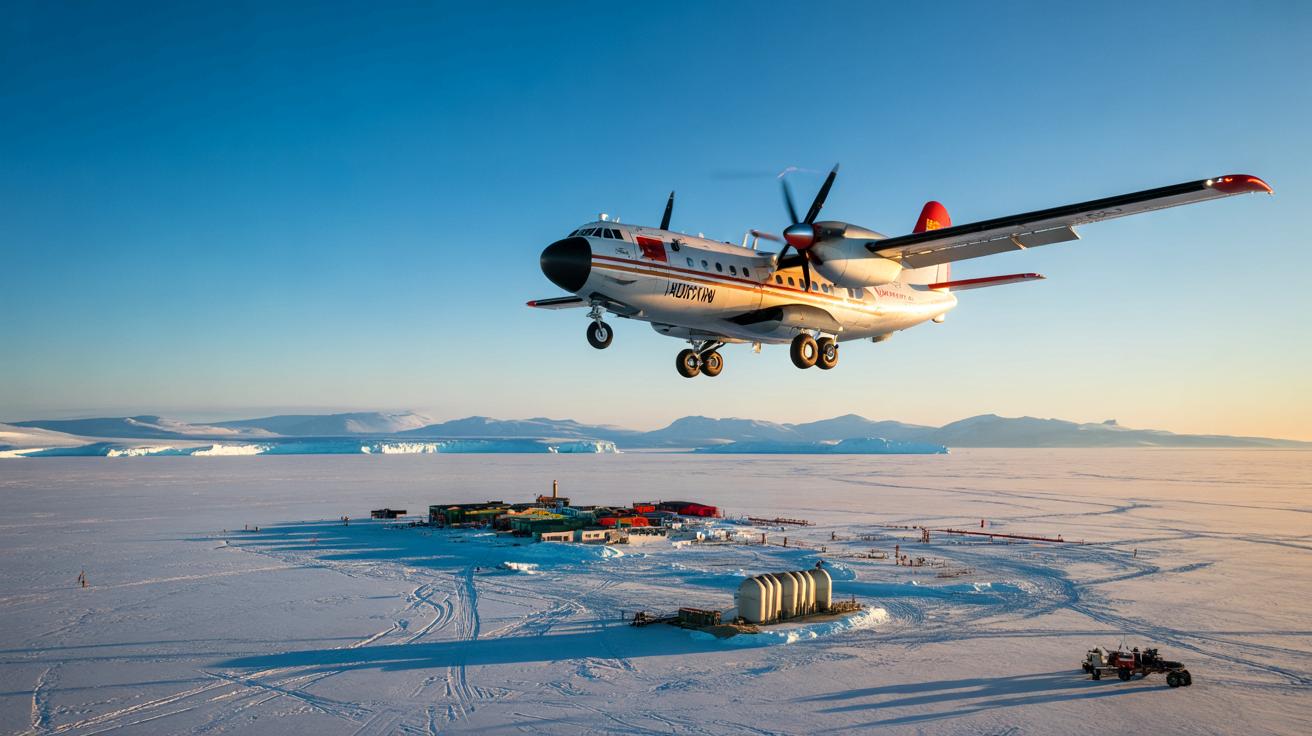
The aircraft at the centre of this shift is Xueying 601, literally “Snow Eagle 601”. For a decade, it has formed the aerial backbone of China’s Antarctic programme.
Put simply, this is not “just any plane”. It is the machine that lets Beijing supply, maintain and expand a scattered network of polar bases while collecting data that feeds directly into global climate models.
Without Xueying 601, China’s Antarctic ambitions would stay largely coastal. With it, Beijing reaches deep into the interior ice.
During the 42nd Chinese Antarctic expedition in December 2025, the aircraft launched its first science flights of the season. Those missions did more than move fuel drums and spare parts. They extended an emerging Antarctic air corridor, with Zhongshan Station acting as a central hub linking over 20 Chinese and foreign bases.
That corridor matters for two reasons: it reduces China’s dependence on other nations’ aircraft, and it gives Chinese scientists faster, safer access to interior sites where climate signals are strongest and most pristine.
Building an airport on moving ice
When Xueying 601 entered service, China had no permanent Antarctic runway of its own. The aircraft relied on foreign-operated airstrips and logistics, limiting flexibility and political autonomy.
For Chinese planners, the diagnosis was blunt: no dedicated polar airfield meant no stable, predictable operations. So Beijing chose a difficult route – build where there is nothing but ice and snow.
- 2022: completion of China’s first sled-type polar ice runway near Zhongshan Station.
- March 2023: the ice runway starts regular operations.
- May 2024: the International Civil Aviation Organization assigns the code ZSSW – the Zhongshan Ice and Snow Airport officially enters the charts.
This ice airport now operates on more than 300 days each year. Xueying 601 has already carried out close to 100 take-offs and landings there without any reported incident, an impressive figure given the environment.
➡️ 3,000 liters of hot water a day: Tinkerer needs no electricity, oil or gas
➡️ Hair professionals say this cut is perfect for hair that gets flat by midday
➡️ Which colours make us look older according to psychology?
➡️ Beware black ice: 9 smart ways to avoid winter slips on snow and ice
➡️ Buried under 2 km of Antarctic ice, scientists discover a lost world 34 million years old
An ice runway constantly shifts, cracks and melts at the edges. Safe use demands relentless measurement and strict procedures.
By proving that ZSSW can support sustained operations, China signalled that its Antarctic presence is not seasonal tinkering but a long-term strategic commitment anchored in infrastructure.
A workhorse in brutal conditions
Over ten years, Xueying 601 has logged more than 1,100 days of operations, 2,500 flight hours and around 800,000 kilometres – about 20 laps around the equator.
Those are not air-show numbers. They are reliability statistics in a place where mistakes can kill quickly. A polar aircraft must deal with extreme cold, low air density, long distances over featureless white and runways with almost no tolerance for error.
In this environment, every take-off tests engines, de-icing systems and pilot judgement. Every landing tests navigation, braking on ice and the quality of on-the-ground runway surveys.
More than cargo: a flying research platform
Officially, Xueying 601 is a combination cargo and research aircraft. It ferries freight, fuel, scientific instruments and rotating teams of researchers between Great Wall, Zhongshan, Taishan, Kunlun and foreign stations.
Yet its real impact lies in its “second career” as a flying laboratory. Since 2016, the aircraft has been used not only to deliver equipment, but to test the limits of high-altitude polar flight over Kunlun Station, perched more than 4,000 metres above sea level on the Antarctic plateau.
A year after its first overflights there, Xueying 601 managed to land and take off on site. That success opened the door to more regular operations over the interior plateau, where air is thin, temperatures plunge and any emergency response is agonisingly far away.
In 2023, the aircraft carried out a first landing in the Grove Mountains region of East Antarctica, sketching a potential new corridor for emergency evacuations and rapid field deployments.
Seeing through ice: mapping Antarctica’s hidden landscape
Where Xueying 601 stands out most is in its ability to sense what lies under hundreds or even thousands of metres of ice.
Equipped with specialised scientific instruments, the aircraft has collected over 200,000 kilometres of observation data, especially across Princess Elizabeth Land and other key sectors of East Antarctica.
These flight lines reveal the bedrock under the ice, the hidden valleys and ridges that control how glaciers move and melt.
The data helps researchers build high-resolution maps of subglacial topography, estimate heat flow from the Earth’s interior and trace buried geological structures. That knowledge feeds into forecasts of how fast ice sheets can destabilise – and how much sea level could rise this century and beyond.
Without such measurements, ice-sheet models are forced to guess what lies below. That guesswork translates directly into bigger uncertainties for coastal cities from Miami to Mumbai, and for long-term planning in low-lying regions.
Tool of cooperation – and of influence
Antarctica remains governed by an international treaty that bans military activity and emphasises science. Within that framework, logistics are still power.
Xueying 601 lets China offer flights, share capacity and join coordinated observation campaigns. Beijing participates in the RINGS group under the Scientific Committee on Antarctic Research, working with Norway, Australia and others on monitoring East Antarctica’s ice margins, particularly around Enderby Land.
Since 2024, China has also taken on partial airspace management duties around Zhongshan Station. That includes drawing up and trialling operating rules, and aligning them with international standards for polar aviation safety.
Every safe flight by Xueying 601 strengthens China’s technical credibility and informal influence in Antarctic decision-making circles.
Part of a small, specialised club
China’s “Snow Eagle” belongs to a short list of fixed‑wing aircraft that keep Antarctic science and logistics running. Different nations rely on different machines, each with distinct strengths.
Key Antarctic fixed-wing aircraft in 2026:
| Aircraft | Operating countries | Main role | Land on ice | Notable feature |
|---|---|---|---|---|
| Xueying 601 | China | Logistics + science | Yes | Full scientific payload |
| Basler BT-67 | US, partners | Heavy logistics | Yes | Very rugged, long-lived |
| Twin Otter | UK, EU, Canada | Science & light missions | Yes | Short take-off, precise operations |
| C-130 Hercules | US | Strategic cargo | Yes (with skis) | High payload capacity |
| Il-76 | Russia | Mass transport | Partial | Very long range |
Xueying 601 sits somewhere between these categories – more flexible than a giant Hercules, more autonomous than a tiny Twin Otter. That hybrid positioning lets it act as both logistics truck and sensing platform, creating and maintaining new air routes while gathering scientific data along the way.
Antarctica as a Chinese climate laboratory
Behind the aircraft and runways lies a broader Chinese strategy: build a continuous, continent‑wide observation system.
China now runs several Antarctic stations, from coastal outposts to high‑plateau sites above 4,000 metres. They focus on oceanography, glaciology, geophysics, astronomy and atmospheric science, and they operate in a network rather than as isolated camps.
| Station | Year opened | Location | Main research fields | Key role |
|---|---|---|---|---|
| Great Wall Station | 1985 | King George Island, Antarctic Peninsula | Marine biology, coastal climate, geology | First Chinese base, gateway for cooperation |
| Zhongshan Station | 1989 | Coast of East Antarctica | Glaciology, meteorology, geophysics | Logistics and air hub for Xueying 601 |
| Kunlun Station | 2009 | Dome A, interior plateau (> 4,000 m) | Astronomy, upper atmosphere, deep ice | Ancient climate records and ultra‑clear skies |
| Taishan Station | 2014 | Between coast and plateau | Glaciology, geodesy, support | Relay between Zhongshan and Kunlun |
Flights by Xueying 601 are the threads tying this network together. Regular rotations allow long data series, which climate scientists value far more than short, one‑off campaigns.
Why this obscure aircraft matters for everyone else
For many readers, an unfamiliar Chinese aircraft landing on Antarctic ice may sound distant from everyday life. The connection runs through climate risk.
East Antarctica contains enough frozen water to raise sea levels by dozens of metres if it were ever destabilised. That is not a near‑term scenario, but the processes that control its stability are being probed right now by aircraft like Xueying 601.
Better maps under the ice and better measurements in the air mean sharper projections for future sea‑level rise – and fewer surprises for coastal planners.
City authorities studying whether to reinforce sea defences, abandon flood‑prone neighbourhoods or redesign infrastructure depend on model outputs. Those outputs, in turn, depend on field data that come from remote sites only reachable by specialised aircraft.
There is also a geopolitical angle. As Western countries reassess their Antarctic budgets, China is steadily investing in airstrips, ships and research assets. In a treaty system driven by science and presence, that investment converts into voice and influence during negotiations on fishing, protected areas and long‑term governance.
Key polar aviation risks and how they’re managed
Operating aircraft in Antarctica carries a set of risks rarely seen elsewhere:
- Whiteout conditions: sky and ground blend into one, erasing visual references and making landing extremely tricky.
- Fuel margins: long legs with few diversion options mean tight planning and constant weather monitoring.
- Cold‑related failures: hydraulic fluids thicken, batteries lose charge, metal becomes brittle.
- Runway change: ice runways shift, crack or melt; they must be surveyed repeatedly with radar and GPS.
- Medical isolation: any on‑board emergency is far from a hospital; evacuation can be delayed by storms.
Crews flying aircraft like Xueying 601 train specifically for these conditions. They rely heavily on instrument flight, satellite navigation and real-time ice and weather reports from ground teams.
For aviation students and engineers, Antarctic operations offer a real-life testbed for technologies that might later apply to Arctic shipping routes, high‑altitude drones or even future flights on icy moons, where navigation and extreme cold will again be central challenges.