On a mountainous Caribbean island where rain rarely falls where people live, one ambitious pipeline project is quietly becoming a matter of security, health and long-term survival.
France’s Vinci steps in as Jamaica races to secure its water
Jamaica, the third-largest island in the Caribbean, has called on French construction giant Vinci to help tackle a basic but fragile resource: drinking water.
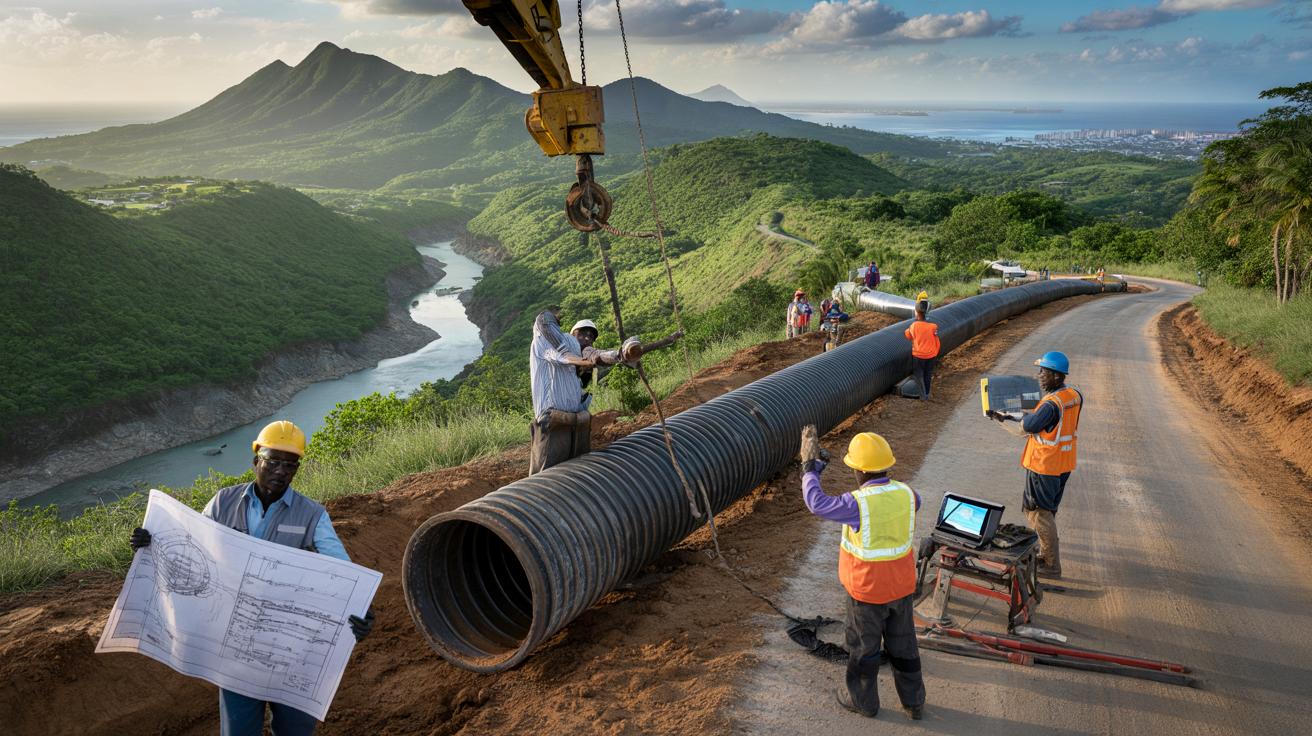
The deal, worth around €144 million, tasks Vinci Construction Grands Projets with designing and building 68 kilometres of new water mains in the island’s north-west.
On paper, it sounds like a fairly standard infrastructure job. On the ground, it is closer to open-heart surgery on a country’s circulatory system.
This €144 million Franco‑Jamaican project aims to stabilise drinking water access for hundreds of thousands of people for decades.
Jamaica’s 2.8 million residents are packed mainly along a thin coastal rim around Kingston and Montego Bay. Inland, the Blue Mountains rise above 2,000 metres, creating steep slopes, scattered rainfall and difficult access.
Climate change is pushing those natural constraints further, with longer dry spells and punchier hurricane seasons. Droughts cut supply. Storms smash pipes and contaminate sources. The timing of rainfall no longer matches the timing of demand.
A climate wake‑up call that turned water into a security issue
The project with Vinci does not arrive out of nowhere. Jamaica has spent the past few years in firefighting mode over water.
In July 2025, the government released 350 million Jamaican dollars (about €1.9 million) for emergency drought measures. Tanker trucks were sent to parched communities. Plastic tanks were bought for vulnerable households. Critical facilities such as hospitals received priority support.
➡️ According to psychology, the way you react to criticism says a lot about your self-esteem
➡️ Buried under 2 km of Antarctic ice, scientists discover a lost world 34 million years old
➡️ How a drop of washing‑up liquid in the toilet can have a surprisingly big effect
➡️ Which colours make us look older according to psychology?
Alongside these quick fixes, the state pushed longer-term actions, especially in agriculture. Farmers received support for drip irrigation and for protecting their fields against erratic rainfall.
On top of that, Jamaica committed some 22 billion Jamaican dollars (around €119 million) to more structural schemes in drinking water, sanitation and irrigation. Officials say the aim is to improve resilience for more than 900,000 residents.
Among these major efforts are:
- the Western Water Resilience Project, which underpins the new Vinci contract,
- the Rio Cobre supply system, built to provide around 57,000 cubic metres of water per day and prevent a repeat of the severe shortages seen in Kingston and Saint Andrew during the 2022 drought.
Kingston’s 2022 shortages pushed Jamaica to treat water infrastructure as a matter of national security, not just a public service.
This shift mirrors a broader trend in climate‑exposed countries: drinking water is being handled with the same strategic lens once reserved for energy or defence.
Sixty‑eight kilometres of pipes, 130 kilometres of problems
The Vinci contract speaks of 68 kilometres of large‑diameter ductile iron pipes. In reality, engineers expect to work along almost 130 kilometres of winding, constricted terrain.
The reason is simple: pipes must snake along existing roads, skirt around villages, navigate landslide‑prone slopes and avoid protected wetlands.
Why ductile iron, and why it matters
The choice of material is highly strategic. Ductile iron pipes cost more upfront than plastic alternatives, but they offer serious advantages on an island like Jamaica.
- Corrosion resistance: better suited to tropical soils and salty coastal air.
- High pressure tolerance: vital for long gradients and steep hillsides.
- Resistance to ground movement: useful in areas that can slip or wash out during heavy rain or storms.
- Long service life: an expected lifespan above 50 years reduces the risk of constant repairs.
The construction phase is planned over 36 months. Around 100 people will be involved on a rolling basis: engineers, surveyors, heavy machinery operators, environmental specialists and local labour.
Project managers describe the worksite as a “moving technical village” that will inch its way along the route, breaking down the job into dozens of short, carefully scheduled segments.
Working with the island’s ecosystems, not against them
One of the trickiest aspects is environmental. Jamaica has asked that the works limit scars on rivers, wetlands and natural habitats.
The project is therefore being carried out in close coordination with Jamaica’s National Environment and Planning Agency.
Each river crossing is treated like a surgical operation, with its own route, depth and construction method to reduce damage.
In practice, that can mean drilling under riverbeds instead of digging them up, or shifting work schedules to avoid sensitive wildlife breeding seasons.
The result is a slower, more deliberate project. Crews cannot simply rush along with excavators. They must adapt constantly to new constraints, from unstable slopes to unexpected underground cavities.
An old partner with fresh responsibilities
Vinci is not a newcomer on the island. The French group has been present in Jamaica since the late 1990s.
That local experience turned into a real‑world test in 2025, when Hurricane Melissa hit. Heavy rains and winds damaged water infrastructure around Montego Bay, Jamaica’s second city.
Vinci teams joined emergency repairs, working under pressure to restore drinking water quickly. That episode gave Kingston policymakers a clear view of which contractors could operate effectively under crisis conditions.
Alongside the new pipelines, Vinci is also involved in building what will be Jamaica’s third‑largest potable water treatment plant, at Rio Cobre. The plant is designed to stabilise supply for a growing population without over‑pumping rivers and aquifers.
A global portfolio of “difficult water” projects
Vinci’s selection is tied to its track record on complex hydraulic work in tough environments. The group has delivered extensive water networks in some of the world’s harshest climates.
| Country | Project type | Timeline | Scale | Key constraints |
| Qatar | Urban drinking and treated water networks around Doha | 2015–2021 | Dozens of kilometres | Extreme heat above 45°C, aggressive desert soils, fast urban growth |
| Australia | Long‑distance transfer pipelines to secure city supplies | 2017–2023 | Dozens of kilometres | Prolonged droughts, large distances, sharp climate swings |
| Morocco | Backbone urban drinking water networks | 2016–2022 | Metropolitan systems | Sensitive crossings, dense cities, demanding environmental rules |
| Algeria | Large‑diameter mains linking dams and major cities | 2014–2020 | Regional axes | Mountainous relief, fast demographic growth, need for constant service |
| Chile | Long‑range pipelines in Andean terrain | 2013–2019 | Long distances | Steep Andes, seismic risk, remote access |
| Peru | Bulk water transport for cities and farms | 2012–2018 | Long distances | High altitude, complex geology, variable river flows |
For Jamaica, this international track record provides some reassurance that the pipelines being buried today will still be reliable when current schoolchildren have families of their own.
What this means for Jamaicans’ daily lives
For households, the technical details will matter less than the lived reality at the tap.
If the project hits its targets, families in the north-west should see fewer restrictions, shorter outage periods and better water pressure during peak demand.
Businesses, from hotels to small workshops, stand to gain from greater predictability. In tourism‑dependent regions, water quality and reliability are now seen as key to keeping visitors and investment.
The new infrastructure also supports public health. Consistent, treated water reduces the risk of waterborne diseases, which tend to spike when residents rely on unsafe wells, rivers or improvised storage tanks during shortages.
Key concepts behind a “resilient” water network
Several technical notions sit quietly behind the political announcements.
- Network resilience: the ability of the system to keep operating despite shocks, such as droughts, storms or equipment failure.
- Redundancy: having alternative routes and spare capacity built into the network, so that one broken pipe does not cut supply to an entire region.
- Non‑revenue water: the share of water lost to leaks or theft before it reaches customers. New pipes and better pressure control can sharply reduce this wastage.
On an island scale, small engineering decisions can have big ripple effects. A better‑sized pipe here may reduce pressure spikes that cause leaks kilometres away. Stronger joints can limit breakages during a hurricane, which in turn shortens repair times and lowers contamination risk.
Future risks, and the choices still ahead
The new Franco‑Jamaican project does not erase all threats. Climate models suggest the Caribbean will face more intense heatwaves, shifting rain patterns and strong storms this century.
That could push Jamaica to move further into alternative sources such as desalination, large‑scale rainwater harvesting or artificial groundwater recharge, each with its own cost and energy footprint.
There is also a social dimension. High‑quality infrastructure is only part of the story. Tariff policies, maintenance budgets, leak detection and clear communication during crises will shape how Jamaicans perceive the value of these investments.
For now, the focus is on getting the pipes in the ground, with as little damage as possible to the environment they cross. The real verdict will come years from now, every morning, when island residents turn on the tap and check whether water still runs.