At Harbin’s sub‑arctic temperatures, where oil thickens like cold syrup, a Chinese‑built turboprop has started and run cleanly, signalling far more than a simple winter trial.
China’s frozen‑start moment in Harbin
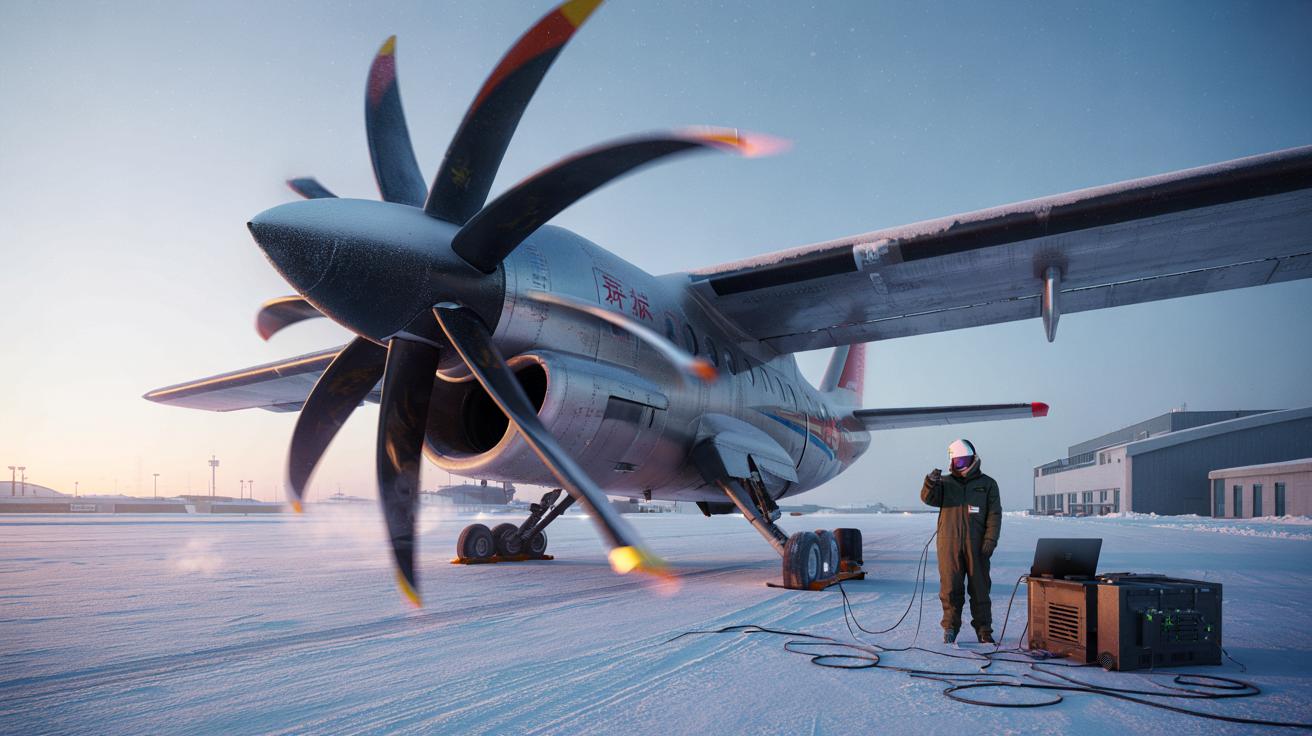
In mid‑winter Harbin, thermometers can plunge to –30 °C. At that point, batteries weaken, lubricants turn sluggish and metal structures shrink and creak. For engine makers, it is about the harshest real‑world exam they can find.
That is exactly where Aero Engine Corporation of China (AECC) chose to fire up its new ATP120A turboprop. The engine did not just cough into life; it reached a stable operating regime under public scrutiny, with engineers watching every parameter.
A successful frozen start shows AECC can move from drawing board to reliable hardware in conditions that punish every weakness.
The test does not yet mean the ATP120A is certified, or even close to entering service. But it marks a clear transition: the project is leaving the stage of laboratory prototypes and entering the long, expensive sequence of full‑scale development.
A quiet industrial revolution at AECC
AECC sits at the centre of Beijing’s broader attempt to remove reliance on foreign powerplants. Formed in 2016 from several state‑owned aerospace entities, it has a mandate that is both simple and daunting: give China its own families of engines for civil and military aircraft, and keep them running over decades.
The group spans fighter jet turbines, large civil turbofans, helicopter powerplants, transmissions and digital control systems. Dozens of production sites and test centres handle everything from high‑altitude simulation to salt‑laden maritime environments.
The ATP120A program falls on the more modest end of this spectrum, yet its symbolism is strong. It is the first civil turboprop fully designed by Harbin Dong’an Civil Aviation Engine, an AECC subsidiary, from clean sheet to complete assembly.
A 1,200 kW workhorse, not a record breaker
The ATP120A delivers roughly 1,200 kilowatts, equivalent to about 1,600 horsepower. That places it in the same general class as established Western engines used on small regional aircraft, special‑mission platforms and large drones.
➡️ What it reveals psychologically when you feel the need to prepare emotionally for simple situations
➡️ Buried under 2 km of Antarctic ice, scientists discover a lost world 34 million years old
➡️ One sock is enough: the grandma trick to clean your blinds like new without effort
➡️ Hair professionals say this cut is perfect for hair that gets flat by midday
From the outset, engineers aimed for dependable performance rather than headline figures. No attempt to break speed or efficiency records; the goal is predictable behaviour, long service life and reasonable fuel burn.
The ATP120A is being pitched as a daily‑use engine for rough fields, tough climates and operators with limited maintenance infrastructure.
Chinese officials have hinted at target platforms such as heavy unmanned aircraft, maritime patrol planes, surveillance aircraft and light tactical transports. Classic airline routes are not the priority. These are “working aircraft” performing tasks like border patrol, logistics to remote regions or coastal monitoring.
Where a 1,600 hp turboprop fits
The power range and operating band of the ATP120A make it suitable for multiple roles. Typical missions for engines of this type include:
- Short‑haul passenger flights to remote communities
- Border surveillance and coastal patrol
- Heavy unmanned systems needing long endurance
- Light cargo links to high‑altitude or rough strips
- Government and civil protection flights, from firefighting to medical evacuation
AECC stresses that the engine is being validated not just for cold weather, but also for high‑altitude plateaus and humid, salty maritime air — three environments that map closely to China’s geography, from Tibet to the South China Sea.
Cold start: when theory meets reality
Starting a turboprop at –30 °C seems simple on paper. In practice, almost everything conspires against you. Metal components contract, affecting clearances in compressors and turbines. Oil becomes thick, delaying lubrication. Fuel atomisation changes. Electronic systems must operate while internal temperatures are barely above freezing.
During a cold‑start test, engineers monitor vibrations, shaft speeds, pressures and temperatures in real time. Any abnormal spike means the design, or the software managing it, needs another loop of redesign.
The first successful ignition is the moment where the equations stop being theoretical and the combustion process proves it can run as designed.
With the Harbin test behind it, the ATP120A will now move into endurance runs, performance mapping and eventually flight tests on a dedicated platform. Many Western programs have stumbled at this stage, as component wear and real‑life use reveal weaknesses hidden in early trials.
A modular engine built as a platform
Beyond the immediate milestone, AECC frames the ATP120A as a starting point rather than a one‑off product. The architecture is described as modular, with room for hybrid variations that pair the turboprop with electric assistance or future hydrogen fuel cell systems.
This approach echoes car manufacturers designing a single chassis to host petrol, hybrid and electric powertrains. The core mechanical structure remains, while electrical and energy storage systems evolve over time.
Turboprops are well suited to this philosophy. They run at relatively steady speeds during cruise, which simplifies integration of electric machines acting as generators or boosters. In hybrid scenarios, the turbine can focus on its most efficient operating band, while batteries handle peak power demands such as take‑off or steep climbs.
From trade show mock‑up to industrial plan
The ATP120A first appeared publicly at the Asia General Aviation Expo in 2025. At that stage, it was essentially a promise: a scale model and some specification sheets.
Since the frozen‑start demonstration, AECC has begun talking about a broader ecosystem around Harbin: design offices, test stands, production lines and maintenance facilities tailored to general aviation engines.
The concept is clear. Rather than a single engine model, AECC wants a stable localisation base for everything from spare‑parts manufacturing to long‑term overhaul, supporting entire fleets for several decades.
Why this matters beyond China’s borders
The geopolitical angle is hard to ignore. For years, Western export controls on engines and parts have complicated Chinese aircraft programmes. Owning a full turboprop line, from design through support, reduces that vulnerability.
There is also a global market dimension. If the ATP120A proves reliable and cost‑effective, it could eventually compete in developing regions where price sensitivity is high and runways are short, from Central Asia to parts of Africa and Latin America.
That would put AECC in competition with established Western manufacturers that have long dominated the 1,000–2,000 hp turboprop niche. Operators may then weigh factors such as acquisition cost, life‑cycle support and political relationships when choosing engines.
Key turboprop applications at a glance
| Application type | Typical aircraft | Main mission | Why turboprop fits |
| Light regional aviation | 10–30 seat commuter planes | Short and medium hops | Good fuel burn, short‑field capability, lower operating costs |
| Utility and work aircraft | Cargo and aerial‑work aircraft | Daily operations, frequent cycles | High reliability and robust maintenance profile |
| Surveillance and patrol | Maritime or land ISR aircraft | Long endurance at moderate speed | Efficient at low and medium altitudes |
| Large drones | MALE/HALE‑type UAVs | Long‑duration flights with sensors | Stable operation for tens of hours |
| Light tactical transport | Small airlifters | Supply runs, rough strips | Good performance from unprepared runways |
What “from A to Z” really means in engine building
When officials boast of mastering turboprop production “from A to Z”, they are not just talking about final assembly. The value lies in dozens of hard‑to‑copy skills.
Designing high‑pressure turbine blades that resist heat and stress. Producing single‑crystal alloys with precise cooling channels. Developing digital engine controls that react in milliseconds to changing conditions. Setting up test rigs that simulate both Himalayan plateaus and sub‑zero Siberian nights.
Each of these steps has its own supply chain, tools and software. For China, bringing them under one roof reduces both foreign dependency and intellectual property exposure.
What this means for future hybrid aircraft
The ATP120A’s modular approach gives a window on possible near‑future aircraft. A hybrid regional plane could, for instance, use the turboprop as the primary power source while electric motors provide extra thrust during take‑off from short mountain strips.
In cruise, the electric side could switch to generator mode, recharging batteries for the next high‑power phase. For missions like surveillance, where aircraft loiter at relatively low power settings, the engine might run close to its best efficiency point while onboard electronics draw from a mix of turbine‑generated electricity and battery reserves.
There are trade‑offs. Hybrid systems add weight and complexity, and they demand new safety rules and maintenance skills. Yet they can also reduce fuel burn and emissions on routes where full electric flight remains unrealistic.
Terms worth unpacking for non‑engineers
The term “turboprop” itself mixes two concepts. A gas turbine, similar in principle to a jet engine, compresses air, burns fuel and expands hot gases through turbines. Instead of using that exhaust mainly for thrust, the turbines in a turboprop drive a shaft connected to a propeller.
This configuration shines on flights at modest speeds and altitudes — the exact conditions of many regional and special‑mission routes. Jet engines excel at high altitude and higher speeds; turboprops win when runway length is limited and fuel budgets are tight.
The “cold start” mentioned in AECC’s communications is another key phrase. It is not just about turning a key in bad weather. For certification and military users, it is a proxy for robustness: if an engine survives the mechanical and thermal shocks of extreme cold ignition, it stands a better chance of holding up to daily service in less dramatic conditions.