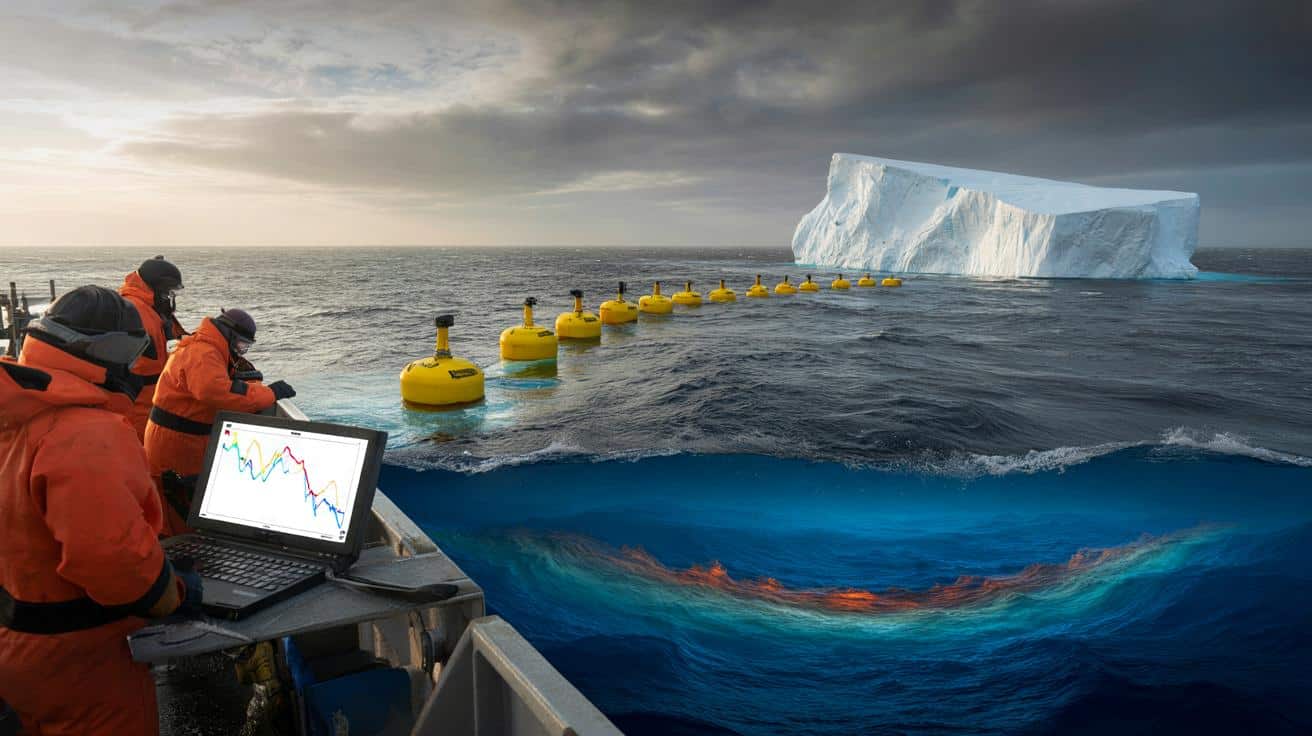
The ship’s metal hull shudders as it cuts through a gray Southern Ocean swell, the kind that seems to come from every direction at once. Scientists on deck squint into the wind, faces stung by fine ice crystals, eyes fixed on a string of yellow buoys bobbing in the waves. Beneath those buoys, thousands of meters down, a hidden river of water has always moved the same way. Northward. Relentless. Steady.
Then the data pings in.
The numbers say that river — one of the key deep currents circling Antarctica — has flipped. For the first time on record, a major Southern Ocean current has reversed its flow. On paper it’s just a negative sign in a spreadsheet. Out here, in this roar of wind and water, it feels like the planet has quietly cleared its throat and issued a warning.
When the ocean suddenly breaks its own rules
For decades, oceanographers have treated the deep currents of the Southern Ocean like the heartbeat of the climate system. Slow, consistent, almost boring in their predictability. Water cooled and thickened around Antarctica, sank, and slid north along the seafloor, helping drive what scientists call the global overturning circulation — a planetary conveyor belt of heat and nutrients.
Then, over a stretch of recent months, instruments anchored off East Antarctica and in key passages around the continent started reporting something no one expected: the flow had turned around. The current was moving south, not north. A traffic jam in the deep.
On one Australian research vessel, the crew watched the first processed graphs appear on a glowing laptop in the lab. A line that had hummed along above zero for years suddenly dipped below and stayed there. The postdoc who’d been babysitting the instruments let out a half‑swear, half‑laugh, thinking it was a calibration mistake. Then the same pattern showed up on data from a second mooring, then a third, hundreds of kilometers away.
Satellite altimeters, measuring tiny changes in sea surface height, hinted that something larger was shifting in the Southern Ocean’s circulation. What had always been a subtle downhill slope for deep water to “roll” north was flattening. That might not sound dramatic. For the people reading those graphs, it felt like hearing your doctor say your pulse had gone from steady to erratic overnight.
Scientists link this reversal to a cocktail of warming oceans, accelerating Antarctic ice melt, and fresh water pouring into the sea from collapsing ice shelves. Fresher water is lighter. It caps the surface, blocking the formation of the cold, very salty, very dense water that normally sinks and drives the deep current. If that sinking weakens, the whole conveyor belt loses its push. When that happens in the Southern Ocean, it doesn’t just stay there. Changes can ripple outward, scrambling weather patterns, shifting monsoon behavior, and trapping more heat in the deep sea. A local flip can hint at a global tipping.
How a hidden current can shake everyday life
One practical way to picture this Southern Ocean system is to imagine the world’s oceans as a vast, slow‑moving escalator. Warm water rides near the surface from the tropics toward the poles. In the polar regions, that water is supposed to cool, grow heavy, and sink back down for the return trip. The Southern Ocean is one of the main points where the escalator turns around. When researchers say that a major current there has reversed, they’re really saying the escalator is stuttering and briefly running the wrong way.
For climate modelers, this is not a niche curiosity. It touches everything from how fast coastal cities see sea level rise, to how brutally heat waves hit inland farmland twenty years from now.
➡️ One sock is enough: the grandma trick to clean your blinds like new without effort
➡️ Buried under 2 km of Antarctic ice, scientists discover a lost world 34 million years old
➡️ Which colours make us look older according to psychology?
Picture a farmer in southern Brazil, already watching rainfall grow stranger and less predictable compared with the stories their parents told. Or a family in Bangladesh, whose kids’ school has flooded for the third time in a single year. These people are never going to read an oceanography paper about “Antarctic bottom water formation.” Yet the same deep current carries part of the blame. When that circulation weakens, warm water can pile up in certain ocean basins, bending storm tracks, drying some regions while drenching others.
We’ve all been there, that moment when the forecast is completely off and a “normal” season just… isn’t. The Southern Ocean’s misbehaving heartbeat is one of the invisible reasons those surprises may start stacking up.
From a physical standpoint, the danger isn’t just the one‑time reversal. It’s what it implies. Repeated slowdowns and flips in that current could be an early sign that the overturning circulation is approaching a tipping point where shifts become self‑reinforcing. Fresh water from melt slows the current, the ocean stores more heat at depth, that warmth eats away at Antarctic ice from below, creating yet more fresh water. A loop. *This is how big systems slide from stable to fragile without any single Hollywood‑style disaster scene.*
Let’s be honest: nobody really tracks “deep Southern Ocean current variability” in their daily life. Yet our food prices, coastal housing markets, and even insurance premiums quietly do. The climate system doesn’t care whether we’re paying attention to its warnings. It just reacts to physics.
What this means for our choices — and what not to panic about
In practical terms, this new current reversal is a flashing yellow light, not a red one. It doesn’t mean the global conveyor belt has collapsed, or that tomorrow’s weather will suddenly spin out of control. What it does mean is that the timeline for certain worst‑case climate scenarios may be moving closer than policymakers had hoped. For everyday people, the most concrete “method” here is painfully familiar: cut emissions faster, and protect the buffering systems — forests, wetlands, healthy oceans — that help keep the climate from flipping into a new, nastier normal.
Pressed for specifics, climate researchers often fall back on the same trio: energy, food, and land. Every solar panel installed, every diesel truck retired early, every hectare of peatland not drained for quick profit buys time for that Southern Ocean heartbeat.
There’s a temptation to either shrug (“too big, too far away”) or to spiral into quiet dread. Both reactions are human. The shrug ignores that this under‑ice current is already linked to more intense marine heatwaves and coral stress in distant oceans. The dread forgets that policy and technology shifts can change trajectories far faster than they did a decade ago. One common mistake is to treat tipping points as on/off switches — as if nothing matters until we cross a line, then everything is lost.
Reality is messier. There are thresholds, yes, but there are also better and worse versions of the future on every side of those thresholds. An Antarctic current flipping once doesn’t mean we’re doomed. Ignoring what it’s telling us would be the error.
“Think of this reversal as the ocean’s equivalent of chest pain during a run,” says Dr. Lena Hofstad, a physical oceanographer who has spent eight seasons on Antarctic cruises. “You can’t say from one episode that a heart attack is guaranteed. But you’d be reckless not to change your behavior and get checked out.”
- Watch the signalsPay attention to stories about Antarctic melt, deep‑ocean warming, and ocean circulation — they’re early warnings, not background noise.
- Support grounded climate actionFrom local zoning that avoids high‑risk coasts to national policies phasing out fossil fuels, these choices bend the curve that controls how extreme tipping risks become.
- Ask better questionsWhen you hear about a new “record” in the climate system, ask: Is this noise, or is this a sign that a stabilizing mechanism is weakening?
- Protect buffers close to homeUrban trees, wetlands, dunes, and restored rivers all help your region cope with the extra chaos a wobbling climate system can deliver.
- Stay out of the all‑or‑nothing trapSmall changes don’t “fix” tipping points, but they change probabilities. That matters more than any neat story of salvation or collapse.
A distant current, a very personal future
The strange thing about the Southern Ocean is how silent it is. No coastal cities, no fishing harbors, almost no human noise beyond the groan of research ships and the occasional helicopter thrum. Yet under that silence, the water is deciding how much heat the planet will hide, where storms will curl, which coastlines will be eaten faster by the sea. A current that quietly flipped direction this year might shape the world your children retire into.
For some readers, this will feel abstract until it touches their own street — until the “once‑in‑a‑century” flood becomes the second in a decade, or the insurance renewal letter comes with a shocking new premium. For others, especially in low‑lying or drought‑prone regions, the connection is already visceral. The deep circulation that kept the climate relatively gentle for most of human history is showing signs of strain. There’s no guarantee on how long that grace period lasts.
The data from those buoys in the Southern Ocean will keep coming. More expeditions will be launched, more graphs will be drawn, more arguments will be had in conference halls over whether we are watching a blip or the first step into a new climatic regime. Somewhere in that mix of equations and political fights sits a simple, unsettling question: how much warning do we really need before we change course?
| Key point | Detail | Value for the reader |
|---|---|---|
| Southern Ocean current reversal | First recorded flip in direction of a major deep current around Antarctica | Signals that climate stability mechanisms are already shifting, not just “in the future” |
| Link to tipping risks | Freshwater from ice melt can weaken the global overturning circulation and trap more heat | Helps explain why distant polar changes can affect local weather, food prices, and flood risk |
| Practical response | Faster emissions cuts, stronger natural buffers, and attention to early warning signs | Offers concrete levers individuals and communities can support instead of feeling powerless |
FAQ:
- Question 1What exactly reversed in the Southern Ocean, and how often does this happen?
- Answer 1Researchers observed a major deep current — part of the Antarctic “bottom water” flow that usually moves northward along the seafloor — briefly switch direction. In the modern instrument record, a reversal of this scale at that location has not been seen before, which is why it has grabbed so much attention.
- Question 2Does this mean the global ocean conveyor belt has already collapsed?
- Answer 2No. The global overturning circulation is still running, but parts of it appear to be slowing and wobbling. The reversal is more like a warning flare that key components are under stress, not proof that the whole system has failed.
- Question 3How could a current near Antarctica affect weather where I live?
- Answer 3Those deep currents help redistribute heat and carbon across the planet. When they weaken or change, warm water and energy can build up in certain regions, altering storm tracks, rainfall patterns, and the frequency of extremes like heatwaves or heavy downpours, even thousands of kilometers away.
- Question 4Is this definitely caused by human‑driven climate change?
- Answer 4Natural variability always plays a role, but the background conditions — warmer oceans, rapid Antarctic ice melt, more fresh water at the surface — are strongly linked to rising greenhouse gas levels. Models have long predicted a slowdown of Southern Ocean overturning under warming; the new observations line up uncomfortably well with those forecasts.
- Question 5What can non‑scientists realistically do about something this huge?
- Answer 5While nobody can “fix” a deep current individually, collective choices matter: supporting policies that cut fossil fuel use, pushing for resilient urban planning, backing protection of forests and wetlands, and voting with your wallet for lower‑carbon options all nudge the system away from its most dangerous tipping paths.