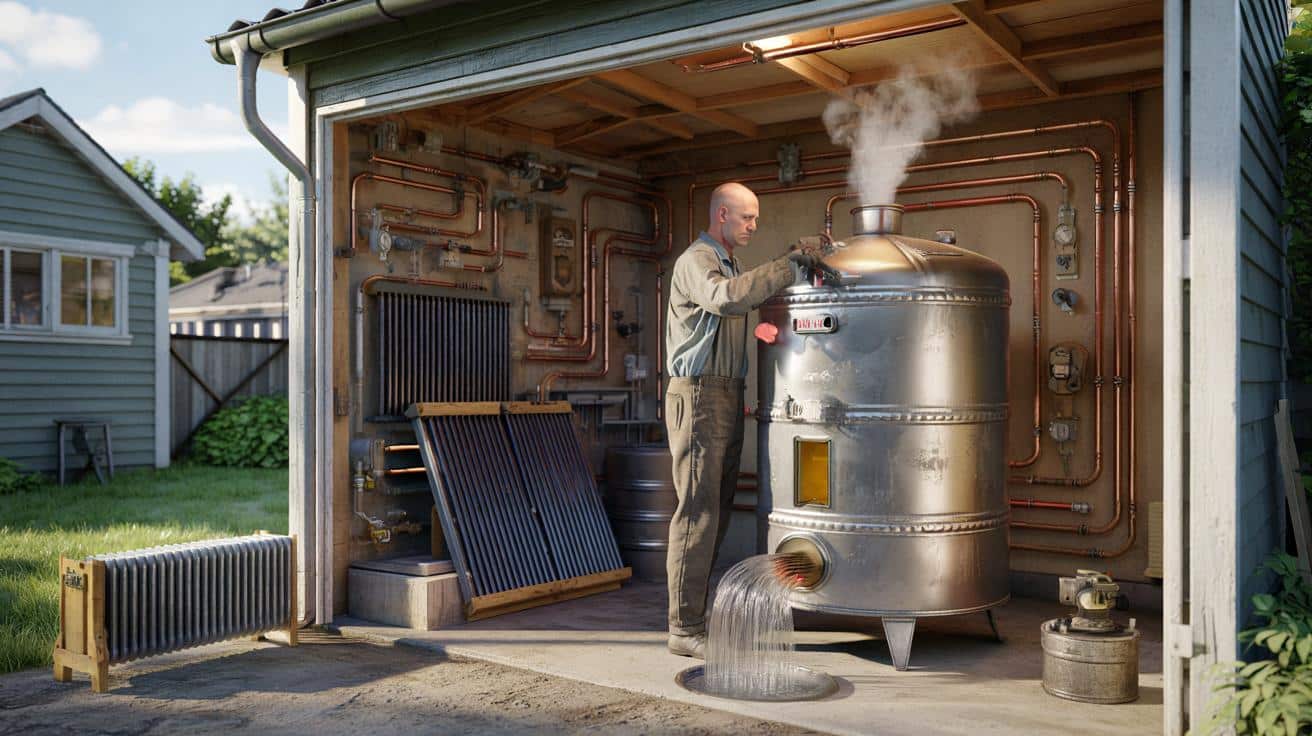
At the end of a quiet cul-de-sac, behind a perfectly ordinary garage door, a metal beast hums softly like a sleeping dragon. Copper pipes coil along the wall, a fat steel tank squats in a corner, and above everything a patchwork of repurposed radiators and black-painted panels glints in the sun. No wires leading to the grid. No fuel line. No heat pump. Just sunlight, air and a man with more patience than most of us can even imagine.
He opens a valve and steaming hot water gushes out. “That’s from today,” he says with a shrug. “Around 3,000 liters. No electricity, no gas, no oil.”
For a second your brain refuses the math.
Then you realize: this is not a gadget. This is a different way of living.
How one backyard tinkerer boils 3,000 liters a day from thin air
The story starts with a simple frustration: energy bills that felt like a second mortgage. Our tinkerer, a 52‑year‑old mechanic who everyone in the village just calls “Marc”, got his wake‑up call during a particularly grey winter, when gas prices spiked and the hot water ran lukewarm for days. He still remembers showering in a cold drizzle and thinking, “The sky is right there, full of energy, and I’m paying to be cold.”
So he did what people like him do. He started collecting things. Old radiators. Scrap copper. Discarded solar pool heaters from a hotel renovation. The back of his house slowly turned into a laboratory made of second‑hand metal and stubbornness.
On a sunny day now, Marc’s system looks like a small industrial plant. A wall of dark, tilted panels catches the sun from breakfast time to late afternoon. Water circulates through them in a closed loop, flowing down into a 3,000‑liter insulated storage tank he welded himself from two decommissioned dairy tanks. Inside, a heat exchanger snake made of copper tubing transfers that captured heat to the actual domestic hot water circuit.
By mid‑day, the thermometer on the tank casually crosses 65°C. There’s enough thermal mass to supply showers for a family, dishes, laundry, and even a small radiant floor circuit. He tracks everything on a notebook, old‑school style. On peak days last summer he logged more than 3,200 liters of usable hot water, all without flipping a single electrical switch.
The logic behind it is brutally simple. You’re not “creating” energy; you’re just catching and storing what falls on your roof anyway. A square meter of sunlit surface receives roughly 1,000 watts at noon on a clear day. Multiply that by several square meters of collector, spread it across five or six hours, and you start to understand how ordinary radiators and dark panels can quietly mimic a small boiler.
What makes Marc’s setup special isn’t exotic tech. It’s scale plus storage. Most people toy with a few solar tubes and a 200‑liter tank. He built something closer to a thermal battery room. **Big volume, strong insulation, simple plumbing** – that’s the triangle doing the magic, far more than any expensive brand name.
➡️ Buried under 2 km of Antarctic ice, scientists discover a lost world 34 million years old
➡️ One sock is enough: the grandma trick to clean your blinds like new without effort
➡️ According to psychology, the way you react to criticism says a lot about your self-esteem
The low-tech recipe behind “endless” hot water
Marc swears the turning point wasn’t a new gadget. It was a decision: stop expecting one single device to do everything. Instead of dreaming of the perfect futuristic panel, he broke the problem down into old‑fashioned parts. First: collect as much sun as possible. Second: move the heat quickly. Third: keep it from leaking away overnight.
He started with ten square meters of scrap radiators painted matte black, mounted in simple wooden frames with cheap glass on top. These became his first collectors. Beneath them, a basic network of PVC and copper pipes, sloped to avoid air bubbles, driven by a tiny circulation pump borrowed from an old heating system. Today he even runs that pump off a small 12V panel so the circulation itself uses almost no grid power.
If you talk to people flirting with solar hot water, the same mistakes repeat like a chorus. They underestimate how well heat escapes if you don’t insulate ruthlessly. They overspend on shiny controllers while ignoring basic pipe diameters. They give up after a couple of cloudy weeks, convinced the concept doesn’t work, when in reality their storage volume is just too small.
Marc approached it like a stubborn hobby, not a weekend project. He wrapped his storage tanks in layers of rock wool and recycled foam until they looked like overstuffed pillows. He shortened every unnecessary meter of pipe. He added simple analog thermometers at key points so he could “feel” the system with his eyes. *That patient tinkering is the part you don’t see in Instagram posts, but it’s the real secret sauce.*
At one point in the conversation, he leans against the tank and laughs:
“Everyone wants a plug‑and‑play miracle. I just stacked basic principles until they behaved like a miracle.”
Then he lists them, almost like a recipe you could scribble on the back of an envelope:
- Oversize your collectors compared to what the catalogs suggest.
- Use the biggest, best‑insulated tank you can physically fit on your property.
- Keep pipe runs short, well‑insulated and slightly sloped.
- Accept that winter yield will drop, and design with that in mind, not against it.
- Track temperatures daily for a few months before declaring success or failure.
What this kind of system quietly changes in a life
Once you’ve seen 3,000 liters of hot water simmering in a big steel tank, the obvious question arrives: why doesn’t everyone do this? The answer lies somewhere between habit, fear of messing up, and the seduction of convenience. There’s comfort in handing responsibility to a utility company, even when it bites your wallet every month.
Yet something subtle shifts when part of your daily comfort comes from your own hands, your own roof. Marc describes the first winter when he barely used his old boiler as “like discovering a hidden income”. Not because he got rich, but because he no longer woke up worried about prices he couldn’t control.
There’s a flip side, too. You don’t just install a home‑built solar heater and forget it exists. Once a year he drains the collectors, checks for micro‑leaks, replaces a few worn seals. About once a month he walks around the pipes with his hand, feeling for suspicious cold spots that could mean heat loss. Let’s be honest: nobody really does this every single day.
Still, he insists it’s no heavier than looking after a vegetable garden or a car. The ratio is striking: a few hours of maintenance per year, traded for thousands of liters of fossil‑free hot water. **For him, that deal is non‑negotiable**.
What sticks with you after leaving his workshop isn’t the hardware. It’s the quiet confidence of someone who has hacked a tiny part of the system we’re told is untouchable. We’ve all been there, that moment when you open an energy bill and feel a mix of anger and resignation. Marc’s hot‑water dragon doesn’t solve the world’s problems, but it punctures that feeling just enough to breathe.
He doesn’t talk about saving the planet. He talks about showering long after sunset using heat that fell on his roof at lunchtime. About lending his laundry line to neighbors when their own heater fails. About the strange relief of waking up on a frosty morning knowing that the sun, not a meter spinning somewhere, will decide how hot your day feels. **That’s a quiet revolution hiding behind an ordinary garage door.**
| Key point | Detail | Value for the reader |
|---|---|---|
| Oversize collection and storage | Large surface of collectors plus a 3,000‑liter insulated tank | More consistent hot water and less frustration in cloudy periods |
| Prioritize insulation over gadgets | Thick insulation on tanks and pipes, simple analog thermometers | Maximizes every ray of sun captured, lowering long‑term costs |
| Treat it as a living system | Light yearly maintenance, note‑taking, gradual adjustments | Higher reliability and a sense of control over energy use |
FAQ:
- How much space do you need for a 3,000‑liter hot water system?
You need roughly the footprint of a small car for the tank and easy access to a sun‑facing roof or yard wall for the collectors. Many people scale down to 800–1,500 liters to fit basements or sheds while keeping the same basic idea.- Can a DIY solar hot water system work in cloudy or cold climates?
Yes, but the yield drops and design matters more. You compensate with more collector area, better insulation, and sometimes a backup heat source. The system still cuts fossil use dramatically, even if it doesn’t cover 100% year‑round.- Is it safe to build something like this yourself?
The plumbing is fairly simple, but hot pressurized water can be dangerous if mishandled. Many tinkerers do the design and rough work themselves, then pay a certified plumber to check connections, safety valves and expansion vessels.- How much can you realistically save on bills?
Numbers vary, yet cutting 50–80% of water‑heating energy is common once the system is tuned. For a typical household, that can represent several hundred to over a thousand euros or dollars per year, depending on local prices.- Do you need batteries or a full solar power system?
No. Solar thermal systems like Marc’s store energy as heat in water, not as electricity. A tiny circulation pump is often the only powered component, and even that can run from a small standalone panel if you want to stay off‑grid.