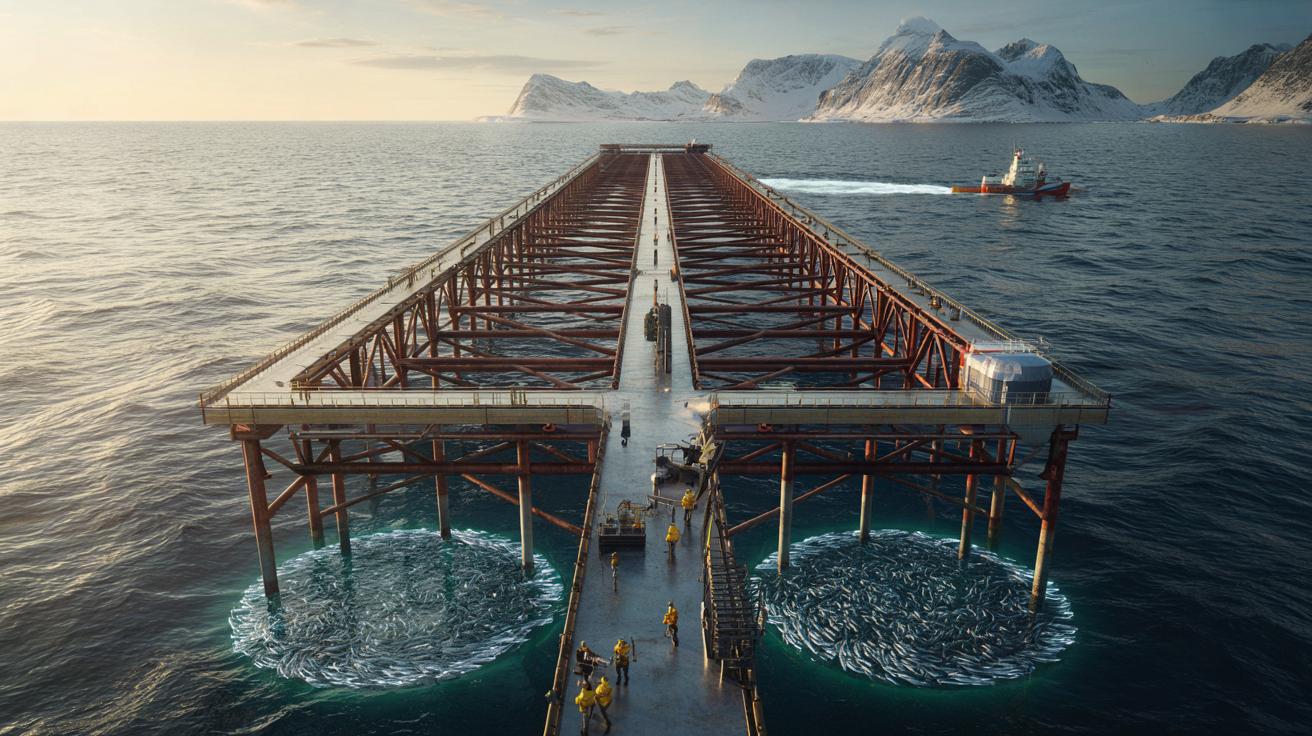
Up close, the truth is far stranger.
Anchored several kilometres off northern Norway, a 385‑metre steel colossus is quietly rewriting how salmon are farmed, wave after wave, season after season.
A “ship” that doesn’t sail and doesn’t carry people
Seen on radar, the Havfarm could be mistaken for a large container vessel. It stretches longer than four football pitches and spans almost 60 metres across. Yet it transports no containers, cars or cruise passengers.
This floating giant is packed instead with living cargo: thousands upon thousands of Atlantic salmon, raised in six huge circular enclosures hanging beneath its deck.
Havfarm 1 can hold up to 10,000 tonnes of salmon at once, making it one of the largest single farming units on the planet.
The structure belongs to Nordlaks, a major Norwegian seafood company that ran out of room in the country’s narrow fjords. Together with design firm NSK Ship Design, it set out to push salmon farming offshore, into deeper, rougher water traditionally reserved for oil platforms and heavy shipping.
Rather than a classic ship’s hull, Havfarm resembles a long open truss of steel. The frame extends more than 30 metres below the surface, where the salmon cages are suspended. From above, the layout looks like an industrial pier marooned at sea.
Built to ride 10‑metre waves
Operating five kilometres off the island of Hadseløya, in the Vesterålen archipelago, means Havfarm lives with North Atlantic weather most fish farms never face. Winter storms routinely send waves rolling in at several metres high.
The platform is semi‑submerged and self‑stabilising. Heavy ballast and the depth of the structure keep it from pitching and rolling too hard. The system is engineered to tolerate waves of up to 10 metres, with an automatic uplift mechanism that raises parts of the structure in extreme conditions.
Power comes from shore through subsea cables. That allows the farm to run lighting, feeding systems and monitoring gear without diesel generators humming on deck. A hybrid “wellboat” — a vessel with onboard tanks for live fish — services the platform, transporting salmon to processing sites while using liquefied natural gas (LNG) to cut emissions.
➡️ Which colours make us look older according to psychology?
➡️ One sock is enough: the grandma trick to clean your blinds like new without effort
➡️ What it reveals psychologically when you feel the need to prepare emotionally for simple situations
➡️ Hair professionals say this cut is perfect for hair that gets flat by midday
Daily tasks that once required small service boats are handled by automated trolleys running on rails embedded in the steel skeleton.
These robotic carts move feed, equipment and staff safely along the 385‑metre span, lowering the number of boat trips and reducing the risk of accidents in rough seas.
Havfarm 2: when a fish farm starts behaving like a ship
The next step in Nordlaks’ plan goes further. Havfarm 2 is being developed as a movable offshore unit, essentially a slow‑moving vessel devoted entirely to aquaculture.
Ship-grade technology for fish farming
Unlike the first, fixed Havfarm, the second generation will be equipped with:
- Rolls‑Royce TT1100 azimuth thrusters, commonly used on offshore support ships, to generate thrust in any direction.
- Dynamic positioning (DP) software and sensors, allowing the farm to hold a precise heading or shift orientation to face oncoming waves.
- Single-point mooring rotation, so the whole structure can swing around one anchor point, spreading organic waste over a broader area.
This combination gives Havfarm 2 some of the manoeuvrability of a ship. If conditions at one site deteriorate, it could, in principle, relocate to another approved area without a full towing operation.
By letting the farm rotate and gently reposition, engineers aim to reduce seabed erosion and avoid concentrating pollution in one spot.
The design responds to two main pressures on the industry: tightening environmental regulations near shore, and growing global demand for salmon. Instead of expanding in sensitive fjords, operators are looking outward, to more exposed zones where currents are stronger and space is less contested.
A floating testbed for “cleaner” aquaculture
Fighting sea lice with steel skirts
One of the biggest headaches for salmon farms in northern waters is the sea louse, a tiny parasite that clings to fish skin and can cause severe damage. Conventional farms often rely on chemical treatments or thermal baths to keep infestations down.
Havfarm uses a mechanical shield. Along the sides of each cage, steel “skirts” drop roughly 10 metres below the surface, forming a barrier where lice larvae are most concentrated.
By forcing salmon to swim largely below the lice-heavy top layer, the skirts help cut infection rates without constant drug use.
Nordlaks pairs this with another tactic: stocking the cages with larger, stronger juvenile salmon, known as smolts. The company is investing in land-based facilities that rear smolts to a greater size before they are transferred offshore, so they handle marine conditions more robustly and spend less overall time at sea.
Cleaner logistics and fewer fjord impacts
The wellboats that serve Havfarm run on LNG, burning cleaner than traditional marine diesel. Each can carry roughly 600 tonnes of live salmon in temperature‑controlled tanks, reducing the number of journeys needed.
By shifting production offshore, Nordlaks aims to relieve some pressure on fjords already crowded with pens. Stronger currents around Havfarm help disperse organic material — uneaten feed and fish waste — over a wider area, rather than allowing it to pile up directly under cages.
| Criterion | Havfarm | Conventional sea farm |
| Location | Open sea, ~5 km offshore | Nearshore fjords and sheltered bays |
| Main structure | Semi‑submerged steel platform | Individual floating plastic rings |
| Wave resistance | Up to 10 m significant wave height | Typically 2–4 m |
| Total capacity | About 10,000 tonnes of salmon | Roughly 1,000–3,000 tonnes |
| Mobility | Designed for rotation and, on Havfarm 2, repositioning | Fixed moorings, no propulsion |
| Parasite control | Steel skirts, deeper swimming zone | Net pens plus chemical or thermal treatment |
| Environmental impact | Waste spread out by strong currents | Localised build‑up beneath pens |
Backed by the Norwegian state – with strings attached
Norway’s government sees offshore aquaculture as a strategic bet. To encourage risk‑taking, regulators created special research and development licences. Nordlaks received several for the Havfarm concept.
These permits allow the company to operate experimental technology without paying the full commercial licence fees, which are notoriously high. In return, Nordlaks must collect data and demonstrate that the new approach can meet strict sustainability goals.
If those conditions are met, temporary R&D licences can later be converted into discounted long‑term production licences.
The scheme effectively uses access to future production as a carrot to push companies toward cleaner, more space‑efficient systems. Industry groups argue that, without this flexibility, large offshore projects like Havfarm would struggle to reach the water.
Commercial reality: does the giant actually work?
Havfarm 1 entered service in 2020 off Ytre Hadseløya and has since been running as a fully fledged production unit. Nordlaks reports a stable output of roughly 10,000 tonnes of salmon, alongside lower emissions from service operations thanks to its electrification and automation.
Monitoring cameras and sensors track fish behaviour, feed intake and water quality in real time. Early experience suggests fewer disease incidents than in some traditional sites, partly due to cleaner water flow and the lice‑prevention skirts.
The platform has turned into a quiet industrial neighbour: almost invisible from shore, but central to Nordlaks’ long‑term growth plans.
Interest from abroad is rising. Other Scandinavian producers are watching closely, and Asian investors have reportedly contacted the company about exporting the design or partnering on similar projects in new regions.
What “dynamic positioning” means for a fish farm
For people used to cruise ships and tankers, phrases like “DP system” and “azimuth thrusters” might sound remote from salmon. On offshore supply ships, dynamic positioning uses GPS, thrusters and computers to hold a vessel in one place relative to a point on the seabed, even in wind and waves.
Applied to Havfarm 2, the same principle allows the farm to align itself with the sea state. Facing waves head‑on reduces stress on the structure and on the fish cages. It also changes how currents move through the nets, altering how feed and waste drift away.
From a risk perspective, this mobility can be a safety valve. If monitoring indicates that oxygen levels are dropping or that storm tracks are shifting, operators could adjust position or heading within a permitted zone, rather than waiting for problems to build up.
Benefits, risks and what comes next
Offshore giants like Havfarm promise several gains: more space to grow food, lower visual impact on coastlines, and potentially better fish welfare in clean, fast‑moving water. For coastal communities dependent on salmon exports, they also represent jobs and tax revenue in a sector under pressure to cut its footprint.
The risks are real as well. A structure of this scale is complex and expensive. Mechanical failures could have severe consequences for both fish and crew. Critics worry about escapes of farmed salmon into wild populations, or about concentrating large numbers of fish in one offshore site.
Scenario planners in Norway already talk about mixed‑use offshore zones. In future, platforms inspired by Havfarm could share areas with wind turbines or act as hubs for research on kelp and shellfish farming. Combined operations might distribute costs and infrastructure, but they would also add layers of regulation and safety challenges.
For the moment, though, Havfarm remains a striking symbol: a “ship” that does not sail, built not to move freight, but to test how far aquaculture can go when it leaves the calm of the fjords and heads out into open water.